
BLEECAM: Benchmarking Life Cycle Environmental, Economic, and Social Metrics for Critical and Advanced Minerals and Materials
NLR's Benchmarking Life Cycle Environmental, Economic, and Social Metrics for Critical and Advanced Minerals and Materials (BLEECAM™) is an open-source, integrated decision-support tool for evaluating the impacts, risks, and trade-offs across U.S. and global materials supply chains.
Funded by the U.S. Department of Energy, BLEECAM supports supply chain and market analysis. The tool integrates multi-objective supply chain optimization, system dynamics, network design, lifecycle assessment, techno-economic modeling, and social impact assessment methods to evaluate how supply chains evolve over time, geography, and deployment scenarios. BLEECAM also supports analysis related to energy infrastructure, data centers and digital infrastructure, advanced manufacturing, and other sectors that depend on critical materials.
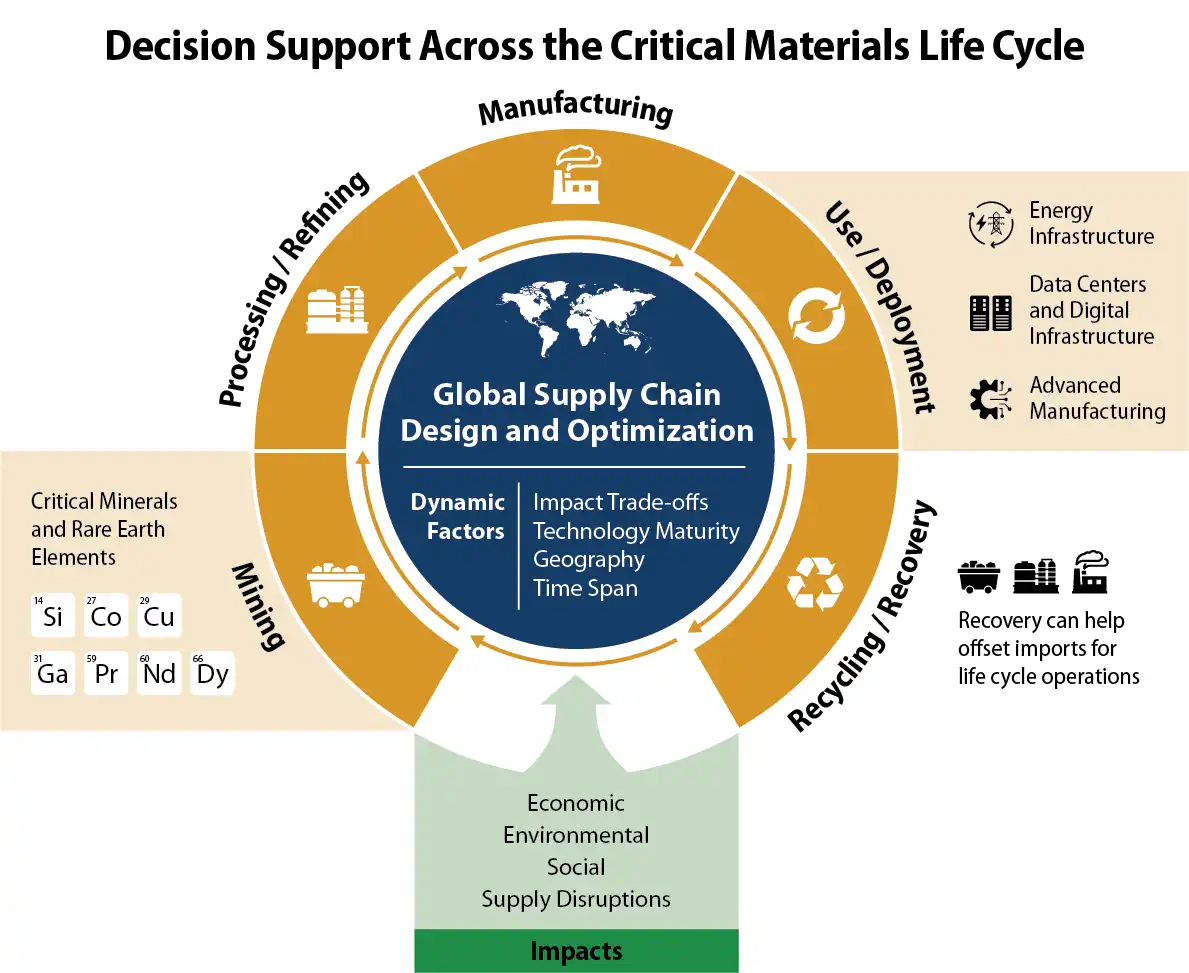
The BLEECAM model is centered around global supply chain design and optimization. The model's dynamic factors evaluate impact trade-offs, technology maturity, geography, and time span. The model spans the entire critical minerals life cycle: mining of critical minerals and rare earth elements; processing/refining; manufacturing; use/deployment in sectors including energy infrastructure, data centers and digital infrastructure, and advanced manufacturing; and recycling/recovery, which can help offset imports for life cycle operations. All of these focus areas feed into the economic, environmental, social, and supply disruptions impacts. Graphic by Elizabeth Stone, NLR
How BLEECAM Works
BLEECAM integrates multiple modeling approaches into a unified analytical framework to benchmark critical materials systems across environmental, economic, and social dimensions. The tool leverages data inputs and workflows from more than 11 specialized, public Department of Energy-funded tools, including U.S. Federal Data Commons and flagship reports from national labs. Learn more on the tool documentation page.
What Users Can Do With BLEECAM
The BLEECAM tool has capabilities from modeling global supply chains to analyzing supply chain networks. When using the tool, users can:
- Model global supply chains from mining and refining to manufacturing, deployment, recycling, and recovery
- Assess domestic and allied supply-chain build-out options by comparing infrastructure needs, siting constraints, and permitting timelines
- Analyze geographically distributed supply networks, production capacities, material flows, process chemistries, yields, and regional dependencies over time
- Compare baseline, policy, technology, and disruption scenarios using consistent economic, environmental, social, supply-chain, and technology-readiness metrics
- Stress-test supply chain resilience against shortages, shutdowns, trade disruptions, shipping delays, and recycling lag times
- Evaluate policy and trade impacts, including tariffs, sourcing rules, incentives, and domestic-content requirements
- Assess emerging technology pathways across cost, scalability, material demand, deployment feasibility, and technology readiness in supply chains
- Benchmark critical materials portfolio across impact, maturity, supply chain relevance, and investment risk
- Identify bottlenecks, alternate sourcing strategies, stockpiling options, and technology pathways to reduce deployment risks.
Applications
The BLEECAM team has applied the framework to mine-to-magnet supply chains for rare earth neodymium iron-boron (NdFeB) permanent magnets and to gallium supply chains. This includes demand driven by power generation technologies, artificial intelligence and data centers, wide-bandgap power electronics, and LED technologies. The team continues to build capabilities for decision-grade platforms. Learn how to partner with us.
Contact
Share

Last Updated Aug. 26, 2026