
Solution to Energy Storage May Be Beneath Your Feet

Anyone who has ever hot-footed it barefoot across the beach on a sunny day walks away with a greater understanding of just how much heat sand can retain. That ability is expected to play a vital role in the future, as technology involving heated sand becomes a potential answer to energy storage needs.
Batteries are likely what most people think about in terms of storing energy for later use, but other technologies such as thermal energy storage (TES) exist—and a combination of energy storage technologies can maximize support for the electric grid. TES may use low-cost materials such as molten salt or sands for storage of high-temperature heat, which is then readily converted into electricity through thermal-power cycles commonly used in fossil fuel or nuclear power plants.
TES shows promise as a low-cost alternative to existing storage technologies for long duration energy storage or supplying industry process heat. Storing energy in solid particles such as sand provides a ready answer, without geological restrictions, unlike other technologies such as pumped hydropower.
After all, sand, like air, is abundant.
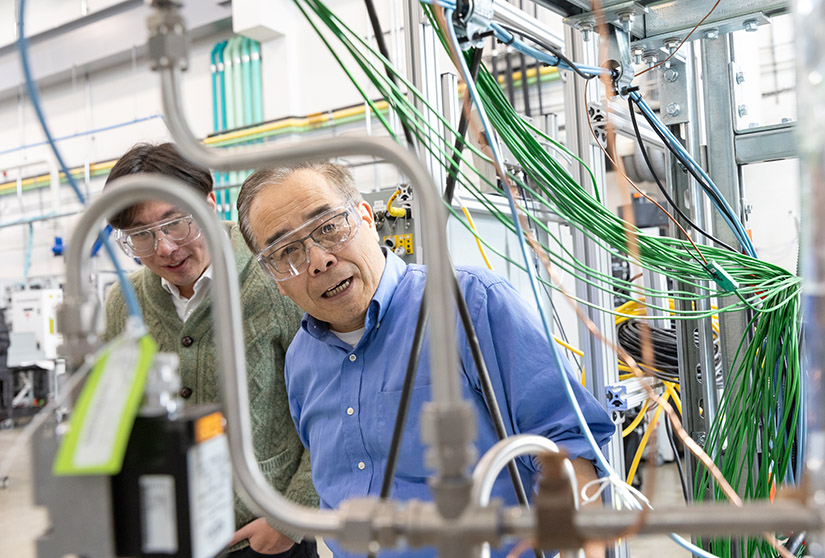
“Sand is easy to access. It is stable, quite stable, in a wide temperature range. It is also low cost,” said Zhiwen Ma, a mechanical engineer in the Thermal Energy Systems Group at the U.S. Department of Energy's National Laboratory of the Rockies (NLR).
Patented technology developed and prototyped at NLR reveals how heaters can raise sand particles to the desired temperature. The sand is then deposited into an insulated silo for storage and use later, either to generate electricity or for process heat in industrial applications. A laboratory-scale prototype validated the technology and allowed researchers to create a computer model that shows a commercial-scale device would retain more than 95% of its heat for at least five days.
“Lithium-ion batteries have really cornered the market at two to six hours of storage, but the electric grid will soon need long-duration energy storage devices beyond six hours—systems that can store energy for days,” said Jeffrey Gifford, a researcher at NLR.
Gifford, who already shares two patents with Ma on heat exchangers that convert stored thermal energy to electricity, said the use of sand or other particles to store thermal energy has another advantage over batteries. “Particle thermal energy storage doesn’t rely on rare-earth materials or materials that have supply chain constraints.”
In addition to TES, Gifford’s expertise is in computational fluid dynamics. That knowledge is important because the sand needs to flow through the storage device. Other TES media includes concrete and rocks, which can easily retain heat but remain solidly in place. “Your heat transfer is much higher and much quicker and much more effective if you're moving your media,” Gifford said.
TES also has another key advantage: the cost. Ma has calculated sand is an attractive option for long duration energy storage when compared to four rival technologies, including compressed air energy storage (CAES), pumped hydropower, and two types of batteries. CAES and pumped hydropower can only store energy under specific geological conditions and are more expensive to build. The cost per kilowatt-hour for CAES ranges from $150 to $300, while for pumped hydropower it is about $60. A lithium-ion battery would cost between $150 and $300 a kilowatt-hour and only have a capacity to store energy for one to four hours. With a duration lasting hundreds of hours, sand as a storage medium would cost from $4 to $10 a kilowatt-hour. To ensure low cost, the heat would be generated using off-peak, low-price electricity.
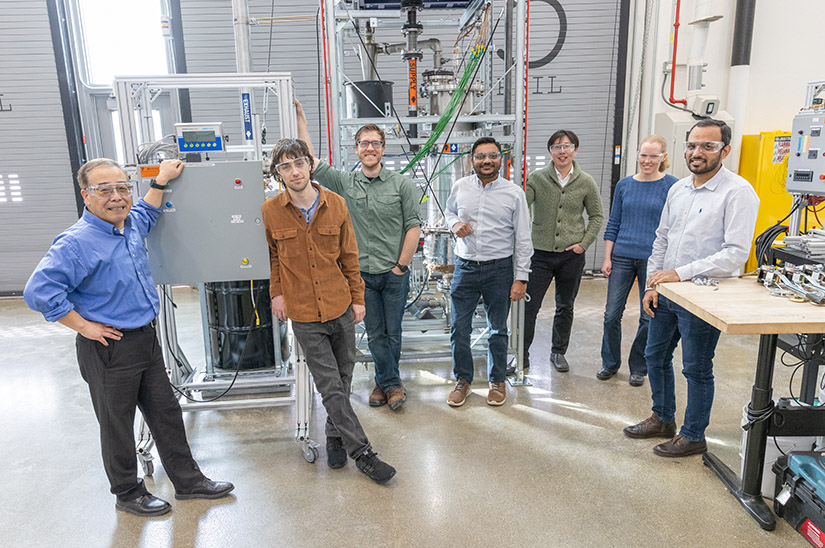
Ma, who holds a handful of patents on the technology, previously served as the principal investigator on an ARPA-E funded project known as ENDURING, for Economic Long-Duration Electricity Storage by Using Low-Cost Thermal Energy Storage and High-Efficiency Power Cycle. Following the success of the ARPA-E ENDURING project, DOE is continuing to support a demonstration of an electric thermal energy storage (ETES) system at NLR’s Flatirons Campus outside Boulder, Colorado, that will be designed to store energy for 10 hours. The modular ETES system under demonstration is scalable in power and storage capacities and free from any siting restrictions that limit where CAES or pumped storage hydropower can be established.
The DOE-funded demonstration project, Ma said, is intended to show a commercial pathway for sand TES for long-duration energy storage on the grid.
The sand Ma intends to use comes out of the ground in the Midwest of the United States and can retain considerably more heat, in the range of 1,100°C (2,012°F) that can store heat for power generation or be used for industrial heat. As a comparison, the molten salt used in the current mature TES technology is subject to a lower freezing temperature limit of about 220°C and an upper chemical stability temperature of around 600°C. If successful, sand TES exhibits a promising market potential with superior thermo-physical properties and lower cost.
“This represents a new generation of storage beyond molten salt,” Ma said.
Deciding What Will Store the Heat
But will just any old sand do? Not according to NLR researchers, who examined various solid particles for their ability to flow and to retain heat. In a paper published in 2023, Ma and others experimented on eight solid particle candidates. Among the particles considered were man-made ceramic materials used in fracking, calcined flint clay, brown fused alumina, and silica sand. The clay and fused alumina were rejected because of thermal instability at the target temperature of 1,200°C (2,192°F).
The ceramic materials outperformed the sand in all categories, but the marginal performance gains were considered insufficient to justify the higher cost. While the sand costs from $30 to $80 a ton, the prices of the mineral materials were about two magnitudes higher. The sand is in the ultra-pure form of alpha quartz and readily available in the U.S. Midwest.
Expanding the amount of energy that can be stored in sand is as simple as adding more sand, Ma said. And while the components needed to convert the superheated sand back to electricity do require an upfront cost, once the system is in place it is more cost effective to add sand to expand storage capacity than the alternative, which is to keep adding batteries.
*This article has been updated to reflect NLR’s new name and an editorial change made after its original publication.
Last Updated April 28, 2026