
As Jet Fuel Supplies Tighten, Can Other Fuels Meet Demand?
New Research Evaluates Potential of 5 Aviation Fuels To Lessen Supply Chain Shocks

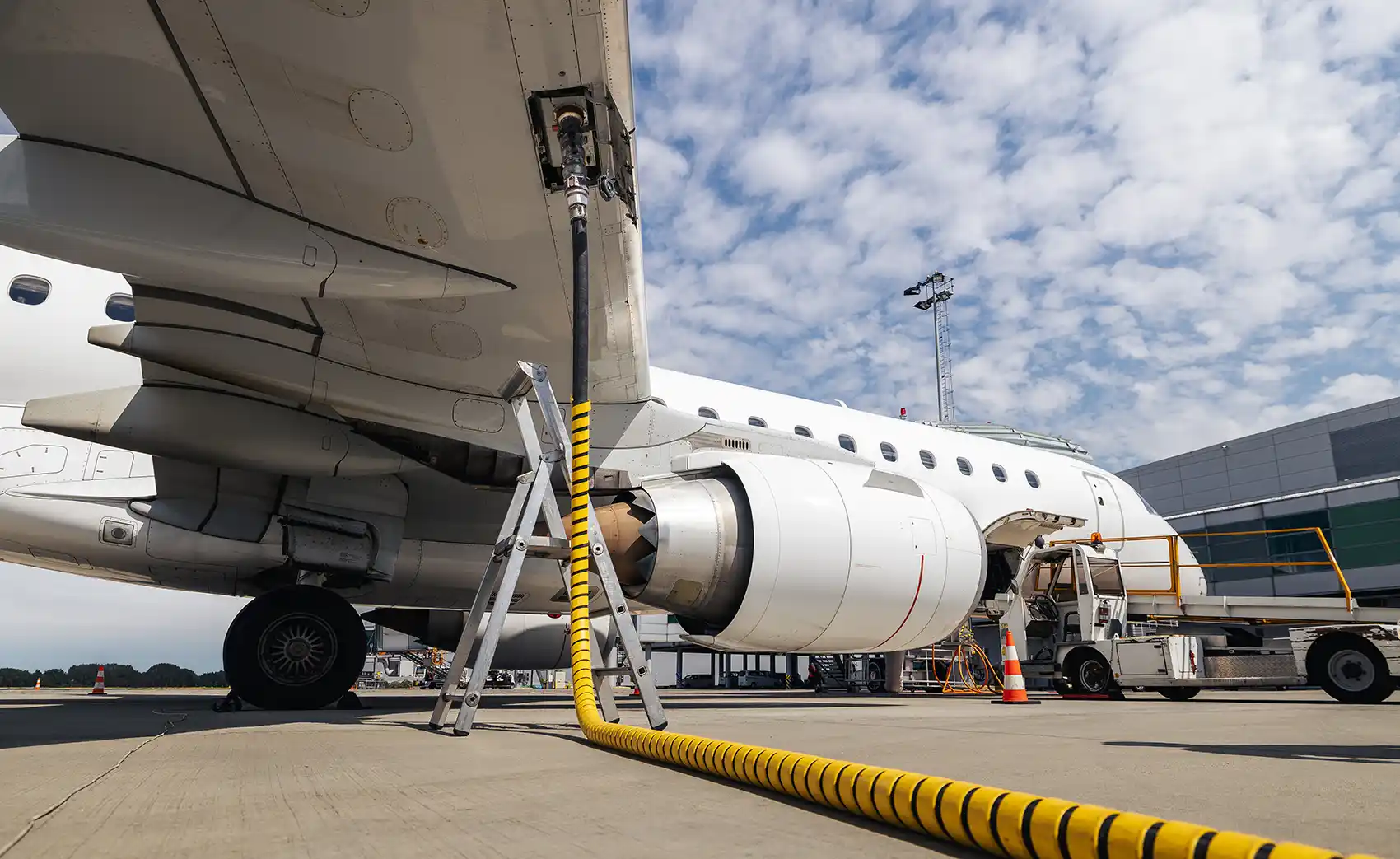
Tight jet fuel supplies—and a growing demand for jet fuel—are intensifying interest in an aviation fuel mix that extends beyond Jet A and A-1, the most widely used aviation fuels in the world. Now, researchers from the National Laboratory of the Rockies (NLR) have released new research evaluating the potential of five emerging fuels.
The flagship report, titled An Overview of Potential Future Aviation Energy Carriers, was funded by the National Aeronautics and Space Administration (NASA) and explores the production potential of five fuels: SAF, liquid hydrogen, liquefied natural gas, liquefied ethane, and Jet X.
Alternatives to Jet A and A-1
A variety of headwinds, ranging from higher price points to infrastructure limitations, have slowed adoption of emerging aviation fuels. Yet they also share a main draw: They can be produced using domestic feedstocks and electricity instead of imported oil, helping insulate the aviation industry and travelers from rising costs caused by supply chain volatility.
“Demand for jet fuel is projected to rise from just over 100 billion gallons in 2025 to 165 billion gallons by 2050,” said Kristi Moriarty, a senior vehicle and infrastructure analysis researcher at NLR who led the study. “With more research into emerging energy carriers, we could give the aviation industry the flexibility it needs to meet these rising demands—and with domestically produced fuels, not imported ones.”
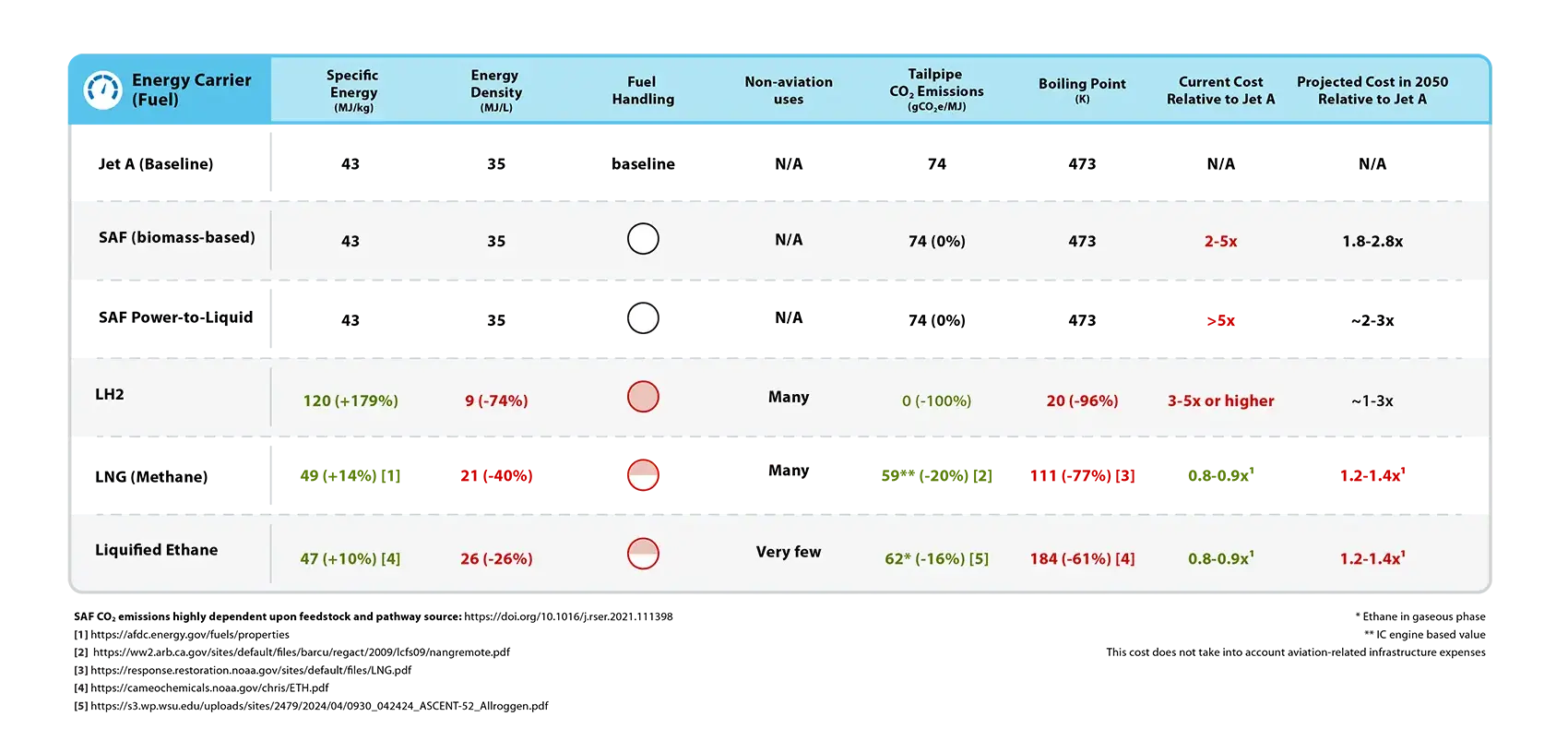
Below, read key takeaways for each emerging aviation fuel.
SAF
Of all the potential fuels surveyed in the report, SAF is already a commercially available drop-in aviation fuel that can replace up to 50% of the Jet A required by traditional aircraft. But unlike Jet A, most SAF is made from fats, cooking oils, greases, and alcohol, and techniques to produce it from biomass, algae, and even municipal waste are underway.
While SAF has been commercially available since 2016, it represents just 1% of jet fuel used worldwide. Adoption has been hindered by its higher price point, which has only rarely fallen below $6 a gallon, and by a limited number of biorefineries that can produce it. Yet as Jet A and A-1 prices surge to $4 a gallon and higher, the price gap between the two fuels is narrowing.
NLR researchers project that, by 2050, global demand for jet fuel may soar to 165 billion gallons a year. There are potentially enough raw materials, also called feedstocks, available for biorefining purposes to produce 80% of that need, or 132 billion gallons of SAF a year.
But if SAF is going to meet future jet fuel demands, it needs buy-in from many stakeholders and further efforts to reduce costs. Producing SAF at the same price as Jet A or A-1 today would prove very challenging: Lower capital and operating costs for new plants and refinery conversions, as well as sufficient feedstocks, would all be needed to produce fuel at scale.
“The transportation fuel market is a global one with a lot of players, including governments,” Moriarty said. “The decisions made at those levels can impact the decisions fuel producers make—whether to build new SAF plants or not, whether to invest in new production pathways or not. And we would need to see accelerated deployment on both fronts if SAF is going to meet future demands.”
Case Study: New England’s Potential for SAF Production

The Massachusetts Port Authority recently funded NLR to study whether SAF could be produced, blended, and dispensed in New England to support 10 New England airports.
Researchers examined local feedstocks, estimated how much SAF could be produced and the price for which it could be sold, and identified where SAF could be blended with Jet A for commercial use.
They found New England has ample feedstock to produce SAF, with potential to produce up to 850 million gallons of gasoline equivalent per year.
Liquid Hydrogen, Liquefied Natural Gas, and Liquefied Ethane
Liquid hydrogen, liquefied natural gas (LNG), and liquefied ethane form a group of “cryogenic fuels”: fuels stored in insulated tanks, often at low temperatures, to maintain their liquid state.
Cryogenic fuels are not drop-in solutions for aircraft. Airports would need to install new fueling infrastructure, and manufacturers would need to bring new hydrogen-, LNG-, and ethane-powered planes to market. International standards would need to be developed for safely handling and dispensing cryogenic fuels.
Yet these fuels also represent a host of benefits:
- Liquid hydrogen is nonpolluting and stores a great deal of energy compared to its weight. Several companies have already begun developing hydrogen-powered aircraft and propulsion systems for short-haul and regional flights, and the Federal Aviation Administration (FAA) is working with NLR to prepare for an anticipated upswing in hydrogen fuel demand at airports.
- LNG can be produced from abundant domestic natural gas and biomethane at a lower cost basis than Jet A.
- While liquefied ethane has seldom been used for propulsion, it offers higher energy density than liquefied natural gas and is seeing a steady rise in production.
“Cryogenic fuels represent longer-term opportunities for the aviation industry,” Moriarty said. “They’re worth exploring because they could help diversify our fuel supply using domestic energy sources, which has important consequences for our energy security—and the prices airlines and consumers have to pay.”
Jet X
Jet X is in early-stage research, and various liquid hydrocarbon chemistries are currently under investigation. Researchers are working to find new fuel chemistries that can increase fuel economy, eliminate toxic aromatics, improve local air quality around airports, and reduce contrail formation.
Extensive, long-term research on Jet X materials, aircraft, and infrastructure would be needed to demonstrate compatibility with airport and aircraft equipment.
NLR Research Is Taking on Fuel
As Jet A prices rise and supplies fluctuate, boosting production of emerging aviation fuels could help stabilize the domestic market. NLR researchers are actively working to clear those new fuels for takeoff. The laboratory’s fuels and combustion researchers are using NLR’s “virtual jet engine” to create ultradetailed simulations of how new jet fuel chemistries perform, which can help speed up production and certification of new synthetic fuels.
Wider research into advanced air mobility—which leverages aircraft that require less jet fuel, or none at all—is also taking flight across the laboratory. Research teams are helping to prepare the aviation sector for the rise of advanced air mobility, inform designs for vertiports for advanced aircraft like electric vertical takeoff and landing aircraft (eVTOL), build propulsion systems for electric passenger aircraft, and design ultraefficient power electronics to help aircraft travel farther on less fuel.
And with continued research, scientists can help lower costs and scale up production to bring emerging fuels to the marketplace—building momentum toward the future of flight.
Partner with NLR to explore the future of aviation energy. Explore related NLR transportation and mobility research and sign up for NLR’s transportation and mobility research newsletter to stay current on the latest news.
Last Updated April 28, 2026