
Going Chiral: How Chiral Copper Selectively Catalyzes Production of Valuable Carbon Products
Experiments Show Chirality-Induced Spin Selectivity Can Control Electrochemical-Reaction Products To Generate Useful Chemicals

Electrochemical conversion of carbon dioxide (CO2) found in air and in geological resources is a promising, economically viable way to generate useful molecules such as carbon monoxide, formate, formic acid, and methanol.
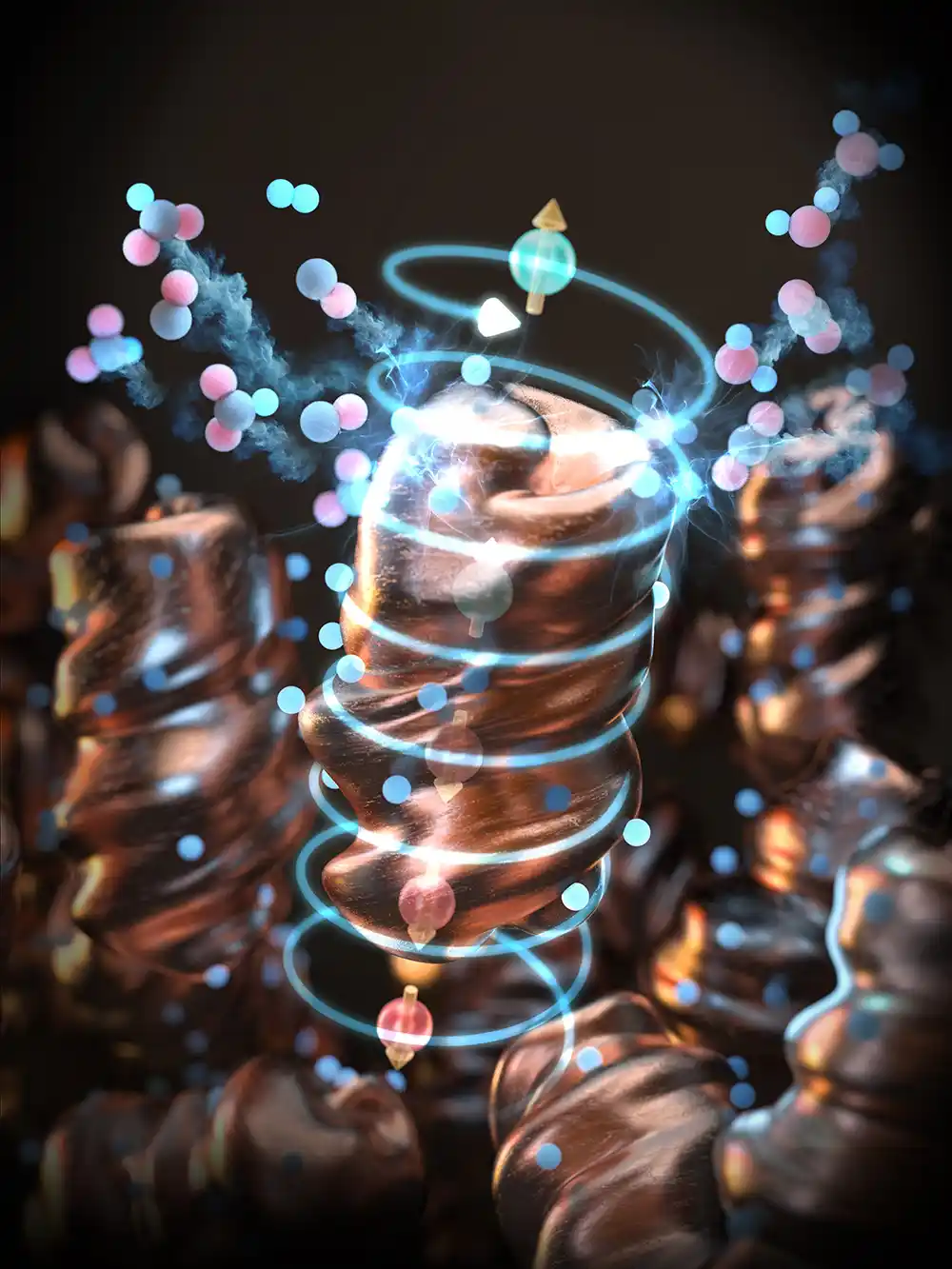
Those molecules can then be used directly or as chemical precursors to produce fuels and other materials such as plastics—allowing people to create beneficial substances for today’s world, literally from air.
Behind this conversion is the CO2 reduction reaction, or CO2RR. One factor limiting the efficiency of CO2RR is hydrogen evolution, which happens as a competing side reaction. Copper is often used as a catalyst in CO2RR because it can generate ample carbon products, but it tends to produce a challenging mixture of different molecules that needs to be purified, while yielding substantial amounts of unwanted hydrogen and smaller amounts of desired products like formate.
National Laboratory of the Rockies (NLR) researchers realized the recently discovered effect of chirality-induced spin selectivity (CISS) could be used to control what chemicals are produced during CO2RR. NLR researchers Jeiwan Tan, Jacob Shelton, Demelza Wright, Md Azimul Haque, Simran Saund, Debjit Ghoshal, Trung Le, Yifan Dong, Michelle Smeaton, Katherine Jungjohann, Elisa Miller, Matthew Beard, Nathan Neale, and Jao van de Lagemaat described their findings in a recently published article in Nature Energy.
The article, “Chirality-induced spin selectivity as a mechanism to control product selectivity during electrochemical CO2 reduction,” details the preparation of helical-structured chiral copper electrode films and shows these structures can improve carbon product selectivity and suppress the competing hydrogen formation. This work is part of NLR’s core photochemistry program funded by the U.S. Department of Energy Office of Basic Energy Sciences.
“We observed efficient production of desired carbon monoxide and formate products during CO2RR, as well as suppression of hydrogen evolution when employing the chiral structures, but not when we used electrodes that have no chirality,” said van de Lagemaat, who led the study. “This tells us that catalytic structures with chirality have a strong effect on these reactions.”
Chirality is a fundamental property of nature. Chiral shapes like spirals or hands always have a left- and a right-handed version that are mirror images and cannot be superimposed on each other—just like how your left and right hands are not the same when you place one on top of the other.
“Chirality is everywhere,” said Beard, director of the CHOISE Energy Frontier Research Center and a colead on the paper, “but its effect on reduction reactions has not been fully appreciated. It now turns out we can use it to control what we make in our electrochemical reactors.”
To prove the results were related to how chiral structures control electronic spin during catalysis, the researchers developed a tool called transient Kerr ellipticity (TRKE), which measures the electron spin alignment as a result of traveling through the sample. TRKE showed that electrons align their spins, or magnetic moments, in the same direction when passing through the chiral structures. Because two opposite spins are needed to form a hydrogen molecule, the resulting polarization of the spins presents a tool to inhibit hydrogen evolution in the electrochemical reactor.
Due to the chirality-induced spin selectivity (CISS) effect, most spins have the same orientation at the surface, and hydrogen evolution is restrained. At the same time, the spin alignment promoted by CISS is beneficial for formate and carbon monoxide production from CO2, leading to higher yields of these products.
These results also highlight the potential for chiral catalysts to control selectivity for other valuable reduction reactions besides CO2RR—for example, those involving nitrogen or carbon monoxide—where hydrogen evolution provides fierce and unwanted competition.
“NLR is uncovering the science behind CISS in a variety of materials and applications, including semiconductors, microelectronic devices, and now fuels and chemicals,” said Jeffrey Blackburn, who leads NLR’s photochemistry research program. “This work is another example of our strategic efforts to explore chirality-based mechanisms to enable next-generation technologies.”
Learn more about basic energy sciences at NLR and about the U.S. Department of Energy Office of Science Basic Energy Sciences program. Read “Chirality-induced spin selectivity as a mechanism to control product selectivity during electrochemical CO2 reduction” and a news and views article about the paper in Nature Energy as well as a research highlight in Nature Chemical Engineering.
Last Updated April 28, 2026