
Put a (Roof) Coat on—It Is Hot Out There
In First Rooftop Demo, Startup, Investors, and Researchers Test Roof Coating’s Potential To Cool, Protect, and Lower Energy Bills for a New Jersey Warehouse

What do a Texas data center, a New Jersey warehouse, and a police academy in Arizona have in common?
They all have roofs. OK, not surprising. But these particular roofs have an extra coating—one designed to keep interiors cool in the summer and warm in the winter, protect the building from ultraviolet sunrays, hail, wind, or other extreme weather, and cut utility bills, too.
“Essentially, we’re putting sunscreen on roofs,” said Matthew Aguayo, a material scientist and structural engineer who is also the cofounder and CEO of EnKoat, the startup that makes IntelliKoat, the roof sunscreen.
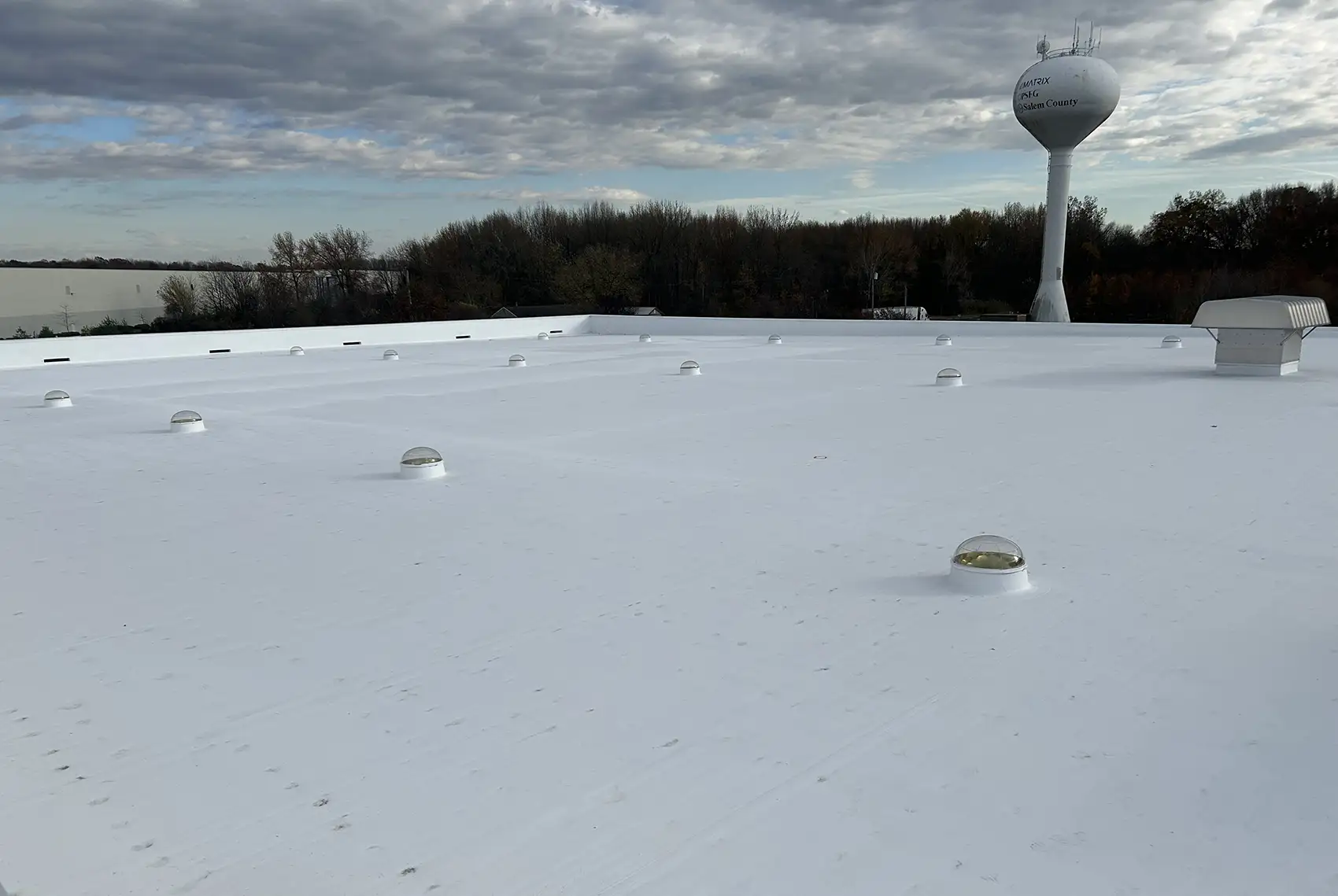
Now, Aguayo and his EnKoat team have applied a fresh coat of sunscreen to a 60,000-square-foot warehouse in Pedricktown, New Jersey. This field study project is possible thanks to support from the Wells Fargo Innovation Incubator (IN2) and a collaboration with IN2 adoption partner Galvanize, a global investment firm.
IN2 is funded by Wells Fargo & Company and coadministered by the U.S. Department of Energy’s National Laboratory of the Rockies (NLR). Through IN2, laboratory experts work with a company to help validate their early- or even later-stage inventions and then connect them to potential users, like Galvanize, to transfer their technologies out of obscurity and into the marketplace.
“What stood out about EnKoat is that this isn’t an off-the‑shelf roof coating,” said Alex Munoz, the managing director and head of asset management at Galvanize Real Estate. “The formulation is purpose built to address both energy performance and material degradation, making it meaningfully different from the products that are widely available today.”
In January 2025, NLR awarded Galvanize $200,000 through IN2’s inaugural Scalable Tech track to, in part, help EnKoat’s IntelliKoat coating go beyond theoretical adoption and get real. That means applying the product on a real-world structure (as opposed to buildings recreated in NLR's virtual models), collecting data (with help from the laboratory’s researchers), and gaining a deeper understanding of how well the sunscreen does what it is expected to do (through in-the-field pilot studies).
“We ultimately make sure that research is not just ideas but implementable products,” said Sajith Wijesuriya, a researcher at NLR who is helping collect and analyze data for the IN2 project. “We help get products to the communities that require them and yield energy benefits as well as cost benefits.”
A 50-Degree Drop
EnKoat’s IntelliKoat coating—which is actually two coats, one for thermal control and one for weather protection—has already yielded benefits for a few customers. After applying their sunscreen to the roof of a 110,000-square-foot data center in Texas, Aguayo said that inside temperatures dropped from 140 to 86 degrees Fahrenheit, a more than 50-degree difference.
“By significantly reducing heat transfer, we prevented the overheating that had been causing repeated equipment failures,” Aguayo said. “After installation, the facility experienced zero heat-related failures and achieved 100% equipment uptime.”
The coating does not just regulate temperature; it can also restore and strengthen aging roofs so owners can avoid costly repairs—at least for a while—or install more equipment up top. EnKoat has also coated the roofs for a Houston-based office project and is working with Arizona’s largest utility to explore whether their invention could help reduce peak energy demand during the state’s sweltering summers.
But even with these early successes, Aguayo is not always sleeping soundly.
“If someone were to ask us what keeps us up at night, it is educating the industry as a whole,” Aguayo said. “Getting owners to understand there’s things you can do to put more money in your pocket and protect your most expensive asset, which is your building.”
IN2 is designed to help companies close these exact kinds of knowledge gaps. EnKoat’s founders know that: The Scalable Tech Track is not their first exposure to the program. After Aguayo and his cofounder, Aashay Arora, discovered their thermally gifted material in the lab at Arizona State University, “everyone was like, ‘OK, you need to do a customer discovery program,’” Aguayo said.
So, they did, through the National Science Foundation’s Innovation Corps (I-Corps). Then they needed a third party—a reputable, conflict-of-interest-free entity—to test their product, so all the potential customers they discovered could trust that the sunscreen worked as promised.
That entity, the reliable third party, is the National Laboratory of the Rockies.
Models to Markets and Risk to Reward
In 2019, Aguayo and Arora applied for Cohort 6 of the IN2 Emerging Tech track for startups—and got in. NLR’s experts first performed their own tests to double-check EnKoat’s stats. Then, using the laboratory’s supercomputers, they explored how widespread application on hundreds or even thousands of buildings across the United States could affect energy demand and prices.
“It was just awesome,” Aguayo said.
“At scale, you can see the magnitude of the energy-saving impacts,” said NLR’s Wijesuriya, who supported this initial EnKoat project, too.
Now, for IN2’s Scalable Tech track (the program’s first track for large-scale field studies), Galvanize collaborated with experts from IN2 and NLR to select EnKoat as their investment partner and help the startup move forward with real-world implementation. Together, the team chose the New Jersey building as their Goldilocks site—a structure that had a portion of roof that is just right to host on-site energy technologies but was beyond the prime age to support such a heavy load.
“We are eager to identify energy solutions that are practical and financially sound,” said Nicolette Jaze, head of sustainability for Galvanize Real Estate. “We’re willing to test new solutions that can meaningfully improve building performance but not at the expense of our fiduciary duty. IN2 helps bridge that gap, allowing us to support promising innovators in an industry that wants change but is cautious about going first.”
In the fall of 2025, they went first: EnKoat’s technicians applied IntelliKoat to the New Jersey warehouse roof to help strengthen it so it could host the new energy infrastructure. NLR researchers also installed sensors to collect data on temperatures inside and outside the building both before and after the coating went on. With that data, they can compare internal building temperatures on similar weather days pre- and post-coating to get a sense of how well the product regulates heat transfer in and out.
“We can clearly see if there are benefits in the quantitative assessment. Rather than just a model, we now have actual field data,” Wijesuriya said.
Models are helpful, but they cannot always replicate the messiness of the real world. If the data from a field study, like this rooftop pilot, matches a model’s predications, that is extra validation a product is likely to work as promised. And that validation is essential for startups, like EnKoat, to earn the trust of its customers.
“This program allows us to go to the people within this market and tell them, ‘You don’t have to believe us. Here’s what we did with NLR in the lab. Here’s what we did with Galvanize on their roof,’” Aguayo said.
“For Galvanize, EnKoat unlocks value in middle-aged rooftops that aren’t ready for replacement but also aren’t viable for new energy installations,” Munoz said.
Galvanize and Aguayo’s EnKoat team also plan to replicate this field test on other rooftops across the United States. More rooftops mean more data, more evidence, and more case studies to show potential customers concrete numbers on how much money they could save in energy bills and how many years they could put off an expensive roof replacement.
“That makes that conversation much easier and opens their eyes to, OK, someone’s not trying to sell me something,” Aguayo said. “They’re really trying to show me that I can do better.”
Ready to tackle your toughest energy questions? NLR can provide the expertise, facilities, and data-driven insights to efficiently advance your technology to market. Discover how we can help. Learn more about IN2.
Last Updated April 28, 2026