
Modular Open-Source Data Acquisition
NLR's Modular Open-Source Data Acquisition (MODAQ) supports emerging energy technologies by providing a complete, verified, and customizable data processing and storage solution.
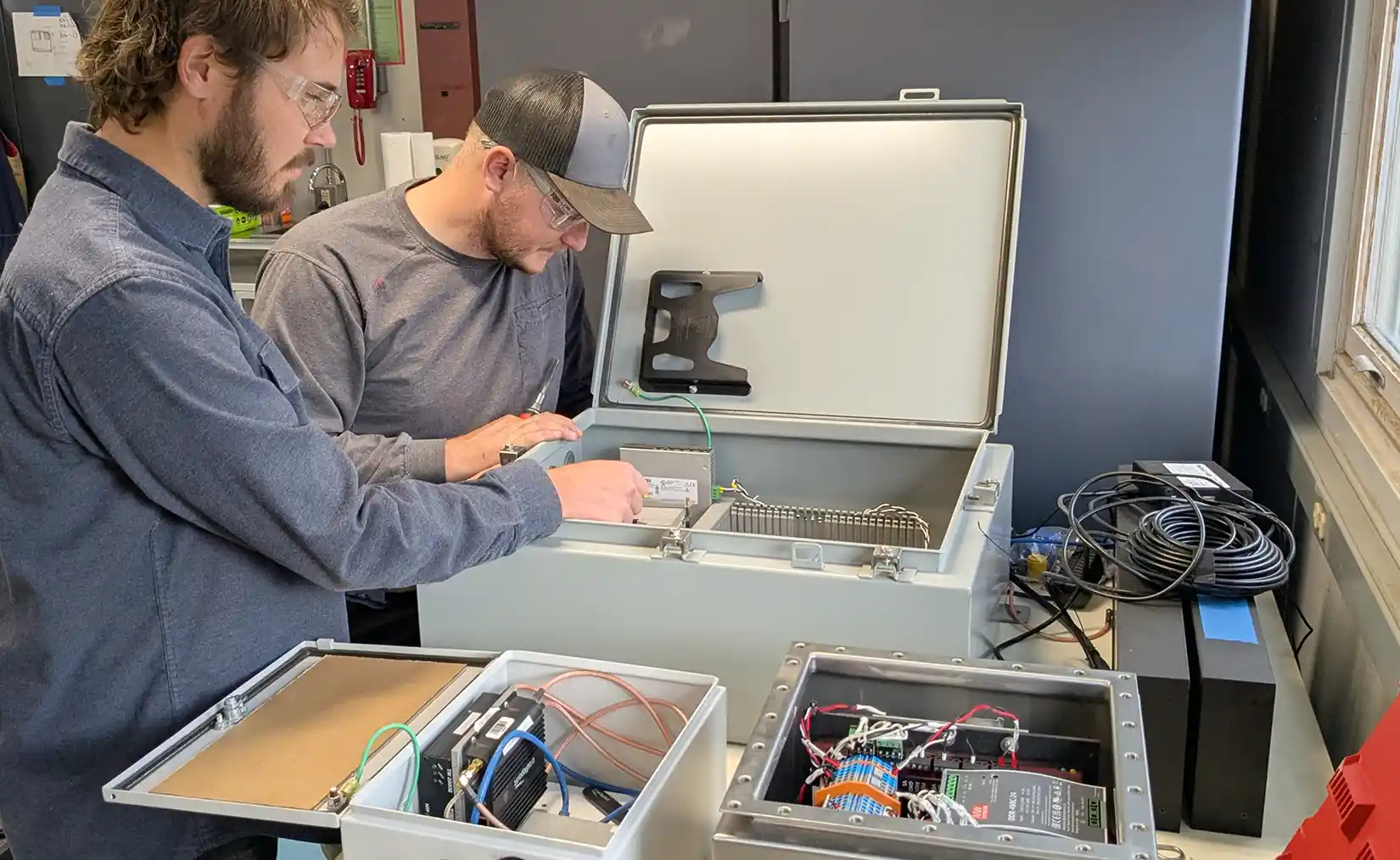
Data acquisition systems are essential for understanding the capabilities and limitations of energy technologies, but they can be challenging to design and customize. With decades of experience, lessons learned, and established best practices, NLR helps industry developers, universities, and other national laboratories achieve their unique data acquisition goals.
To implement a MODAQ system, NLR evaluates these aspects of each bench test or deployment project:
- Objectives and requirements
- Constraints
- System specifications
- Functionality
- Performance
- Channel list
- Control logic
- Instruments and hardware
- Alignment with International Electrotechnical Commission standards
- Data management and communication plans
- User interface
- Risks
- Software development
- Hardware build
- Integration and validation
- Operations.
Each decision involves trade-offs. NLR can help partners understand these choices and their impacts while balancing cost and schedule. NLR has also developed a guide that discusses the considerations for data acquisition planning, design, and execution.
Two MODAQ Architectures: Flexible by Design
There are two MODAQ architectures, both with supporting documentation describing the hardware and software, so users can understand the technical details of each system. NLR specializes in customizing both systems to meet project-specific needs.
MODAQ 1 is the LabVIEW and National Instruments-based system.
MODAQ 2 is the ROS2 and commodity hardware-based system.
| Feature | MODAQ 1 | MODAQ 2 | Notes |
|---|---|---|---|
| Programming language | LabVIEW | C++, Python (ROS2) | |
| Development environment cost | $5,700+ per year or $20,000 perpetual license with 1 year of included updates | Free N/A | M1 requires a subscription to LabVIEW for software development, while M2 uses “free to use” tools such as Visual Studio Code and GCC (GNU Compiler Collection). |
| Synchronization and timekeeping | FPGA ~100ns PTP < 1 ms | PTP < 1 ms | Both platforms use GPS-based systems for accurate timekeeping and synchronization, while M1 can also incorporate an FPGA subsystem for even greater accuracy. |
NLR can also customize the field unit, MODAQ Field, and support implementation of MODAQ Cloud and MODAQ Web applications.
- MODAQ Cloud manages data storage, quality control, formatting, processing, and upload modules and ensures data availability and backup.
- MODAQ Web provides near-real-time summarized data as charts, tables, and plots, so users can stay connected with their device.
Interested in learning more about MODAQ systems or partnering with us?
Contact
Share

Last Updated Oct. 20, 2026