
Computational Applications for Energy Research
NLR's computational applications integrate applied mathematics techniques with high-performance computing to analyze, simulate, and derive insights and advance complex energy research.
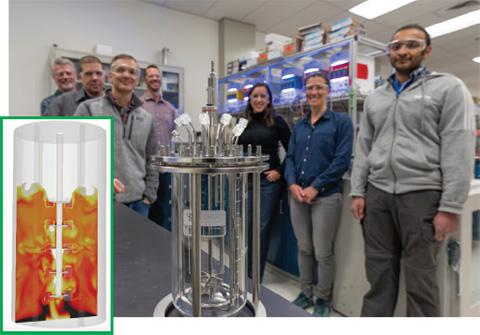
Computational simulations of energy technologies enable rapid prototyping, design and process optimization, physical insights and discoveries, and reliability engineering. These capabilities enable rapid development and deployment of more reliable and affordable energy technologies.
Computational scientists are domain scientists using computers as their primary method of investigating scientific, engineering, and analysis problems. NLR experts in this space focus their research on:
- Techniques for efficient numerical solution of equations describing the evolution
of physical processes—crucial for understanding energy technologies (e.g., fluid flow,
chemical reactions, molecular dynamics, technoeconomic systems) often using high-performance
computing (HPC) systems
- Data-driven methods for developing high-speed alternatives to direct
numerical solutions
- Application-oriented questions that can be solved using these models and simulations. Such questions include the design, optimization, and efficient operation of energy technologies.
Biofuels
NLR's computational research in biofuels delivers tools for the simulation of the full life cycle, including initial processing, chemical conversion, and end use.
Granular flow feedstock must be mechanically or chemically processed before it can be converted to biofuel, and transport simulations can inform design of pretreatment processes.
BDEM: Discrete-Element Simulator for High-Solids Granular Flows (GitHub)
A discrete element method-based simulation tool for modeling high-solids granular flows that include polydispersity, heat transfer,
moving boundaries, and chemistry. The solver provides facilities for simulating spherical/nonspherical particles with modified contact and friction models in complex dynamic geometries defined using level-sets or triangulated files.
Biomass Feedstock Conversion Interface Handling Computational Models
Simulating
the handling and flowability of organic biomass feedstock in coupled feed systems
Biomass pyrolysis is the thermal degradation of organic material for use as a biofuel. Catalytic upgrading is the chemical refinement of biomass-derived intermediates using catalysts to produce stable, energy-dense fuels.
Mesoflow: Mesoscale Modeling Tool for Biomass Pyrolysis and Catalytic Upgrading
AMReX-based code for catalytic upgrading and pyrolysis
Biochemical conversion is the process of using biological organisms or enzymes to transform biomass into renewable fuels, typically through fermentation or enzymatic hydrolysis.
Adaptive Computing Software
Framework for performing multi-fidelity modeling—including in support of Virtual Engineering of Biofuels
BioReactorDesign (BiRD) Simulation Tool
Multiphase fluid dynamics simulations coupled with microbial bioreaction models for aerobic/anaerobic and gas fermentation processes
Virtual Engineering of Biofuels Software
Pipeline of simulation capabilities—including simulation of pretreatment, enzymatic hydrolysis, fermentation processes—for the conversion of biomass into second-generation biofuels
The combustion characteristics of biofuels often differ from those of fossil fuels. This is especially important if the biofuels are intended to be used in fossil-fuel-designed engines without engine modification for accommodating different combustion characteristics.
Aviation Fuels
High-fidelity simulations of biofuels used in aircraft engines to affect performance, fuel economy, and reliability
FuelLib: Jet Fuel Library
Open-source, Python-based library that estimates the thermodynamic and transport properties of fuels
NLR's research in combustion is enabled by Pele Software Suite's PeleC, a compressible turbulent reacting flow solver.
Aviation Fuels
High-fidelity simulations of biofuels used in aircraft engines to affect performance, fuel economy, and reliability
Energy Storage
Computer simulations can quickly and affordably evaluate battery performance and lifecycle.
Chemo-Mechanical Cathode Cracking
A Python-based software tool to model the anisotropic chemo-mechanics of 3D cathode particles at the grain scale within lithium-ion batteries to predict aging, particularly in fast-charging conditions
Meshfree Degradation of Electrochemical Materials
Framework for modeling the degradation (cracking, delamination, and phase change) of electrode materials used in Li-ion batteries, fuel cells, and electrolyzers
SPADES: Scalable Parallel Discrete Events Solvers
Discrete-event-based simulations of the degradation of Li-ion cells
Buildings, Industry, and Transportation
AMAR: Adaptive Mesh and Algorithm Refinement
Simulations of halide perovskites to help discover better manufacturing techniques
Technologies for extracting fresh water from higher salinity sources are needed in regions with diminishing fresh-water resources.
Exagoop (GitHub)
An open-source material point method solver that efficiently simulates the dynamics
of highly deformable continuum phases
NMACFoam Software for Ultra-High-Pressure Reverse Osmosis Membrane and Module Design
and Optimization
Ultra high-pressure reverse osmosis process for water purification
Adaptive Computing Software
Framework for performing multi-fidelity modeling including machine-learning-based
electrical controllers that learn on the fly from simulations of the electrical demands
of communities of buildings
Event-driven simulations of vehicle traffic and mobility systems can help evaluate strategies to relieve congestion. See SPADES: Scalable Parallel Discrete Events Solvers.
Energy Generation
Atmospheric boundary layer modeling can predict how much wind is available.
Exawind Software Suite
AmrWind AMReX-based solver for atmospheric flows, equipped with buoyancy modeling and an efficient hierarchical mesh topology for boundary layer simulations, as well as wind turbine (actuator line and disk) models for wind-farm-scale simulations
Energy Research and Forecasting Model
AMReX-based mesoscale atmospheric code accounting for compressibility effects, terrain modeling, and atmosphere-ocean interactions
Simulates wind loading and stability in solar-tracking PV systems
G2Aero Software: Aerodynamic Shape Parametrization Using Separable Shape Tensors
Data-driven framework uses a matrix manifold to parametrize a manifold of airfoil shapes
Nalu-wind
Part of the Exawind software suite, the fully unstructured, Trilinos-based Nalu-Wind solver simulates flows over complex, moving bodies near wind turbines.
Wind Turbine Stall Modeling
Improved modeling of separated flows and airfoil stall
WindSE
Open-source computational fluid dynamics code simulations, optimization, and uncertainty quantification studies. Written in Python using the FEniCS finite element library, WindSE includes tools to automatically obtain adjoint gradients for efficient optimization and sensitivity analysis in high dimensions.
Contacts
Share

Last Updated Aug. 26, 2026