
EDGES: Enabling Distributed Generation Energy Storage Model
NLR's EDGES framework is a high-fidelity, simulation-based modeling, optimization, and analysis tool designed to evaluate behind-the-meter energy systems under realistic operating conditions.
Static demand profiles and simplified sizing assumptions fall short in accurately modeling highly variable demand loads from emerging energy systems, such as data-intensive digital infrastructure or connected transportation. EDGES integrates system configuration with dispatch and operational constraints at intervals ranging from 1 minute to 1 second. The framework supports evaluating design and operation together to alleviate grid impacts and lower energy costs.
Key Questions EDGES Can Answer
EDGES is intended for site owners, utilities, investors, and regulatory agencies interested in understanding the economic value behind-the-meter microgrid resources can provide for growing electrical loads. Energy providers can also use EDGES to explore how to harness flexibility from microgrid-populated energy networks to avoid infrastructure upgrades and improve reliability.
Typical questions addressed using EDGES include:
- When do operational constraints or control limits affect system feasibility or cost?
- How does demand variability or uncertainty influence storage sizing and dispatch strategy?
- What buffering is required to keep on-site generation within feasible operating envelopes?
- Under what conditions can behind-the-meter systems reduce peak demand or alleviate distribution constraints?
- How do energy reliability targets affect site design and resource dispatch?
- How do degradation and thermal limits interact with dispatch decisions over the system lifetime?
These questions commonly arise in facilities with highly variable loads, limited grid interconnection capacity or stringent performance requirements.
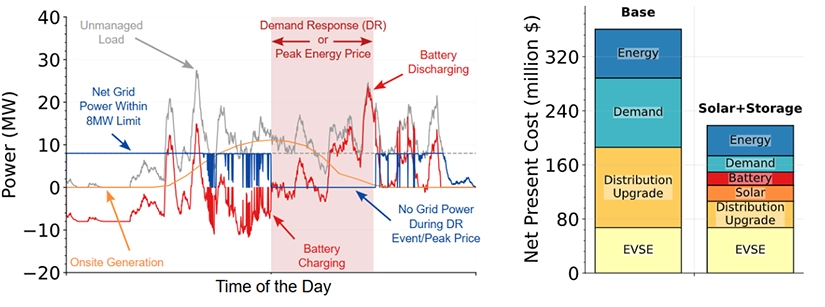
(Left) Modeling demonstrates that on-site generation and storage helps bring down power demand while energy is being generated and eliminates reliance on the grid during peak energy pricing. The generated power helps continue to reduce net grid power demand over the course of the rest of the day. (Right) Incorporating on-site generation and storage reduces system costs compared to a base case. Illustrations by Robi Vercellino, National Laboratory of the Rockies
Modeling Approach
EDGES employs a simulation-based framework that explicitly links system configuration, operational behavior, and economic analysis. Key elements include:
- High-resolution temporal modeling of load, weather, and system operation at 1-minute to 1-second intervals
- Representation of storage, distributed generation, and grid interaction under utility rate structures and interconnection limits
- Control-aware dispatch formulations that reflect ramp-rate limits, cycling behavior, and operational feasibility
- Evaluation of life cycle performance metrics, including degradation effects, rather than single-period cost outcomes.
This approach allows users to assess both economic and operational feasibility across representative scenarios rather than relying on a single deterministic solution. The option to use site-specific data provides more accuracy.
EDGES Applications
Grid-Constrained and Electrified Facilities
As part of NLR's U.S. Department of Energy-funded Athena project Aeroportal modeling platform, researchers used EDGES to inform grid-impact and cost-mitigation strategies for airports across the United States experiencing load growth because of expansions and equipment electrification. These studies examined how coordinated storage and distributed generation can mitigate peak demand, manage variability, and reduce life cycle costs under constrained grid conditions.
Load Uncertainty and Control-Aware Design
Researchers have applied EDGES to evaluate how uncertainty in demand forecasts affects storage sizing and dispatch strategy for electric rental cars at airports. Analyses show load variability and control formulation can materially influence system design outcomes, reinforcing the need for joint evaluation of design and operation.
Dynamic Loads and Dispatchable Generation
EDGES supports screening-level assessments of behind-the-meter power systems serving highly dynamic loads, including artificial intelligence and high-performance computing facilities, to support utilities and other stakeholders balance supply and demand and plan infrastructure expansions. These assessments focus on rapid load variation, operational limits, and the interaction between dispatchable on-site generation and short-duration electrical buffering under realistic operating conditions.
Within this framework, EDGES integrates nonlinear, high-fidelity technology simulation models grounded in experimental data to accurately represent the dynamic response of on-site energy resources, their degradation over time, and how those factors affect investment decisions during planning. Through this modeling approach, EDGES can directly evaluate the economic case for using on-site energy storage to postpone or avoid costly, lengthy infrastructure upgrades.
Microgrid-Style Architectures
Although EDGES is not limited to islanded operation, its integrated treatment of on-site generation, storage, and dispatch aligns with advanced distributed energy systems for microgrid-style applications. EDGES is well suited to behind-the-meter configurations where coordinated operation, demand variability, and grid constraints drive system design decisions.
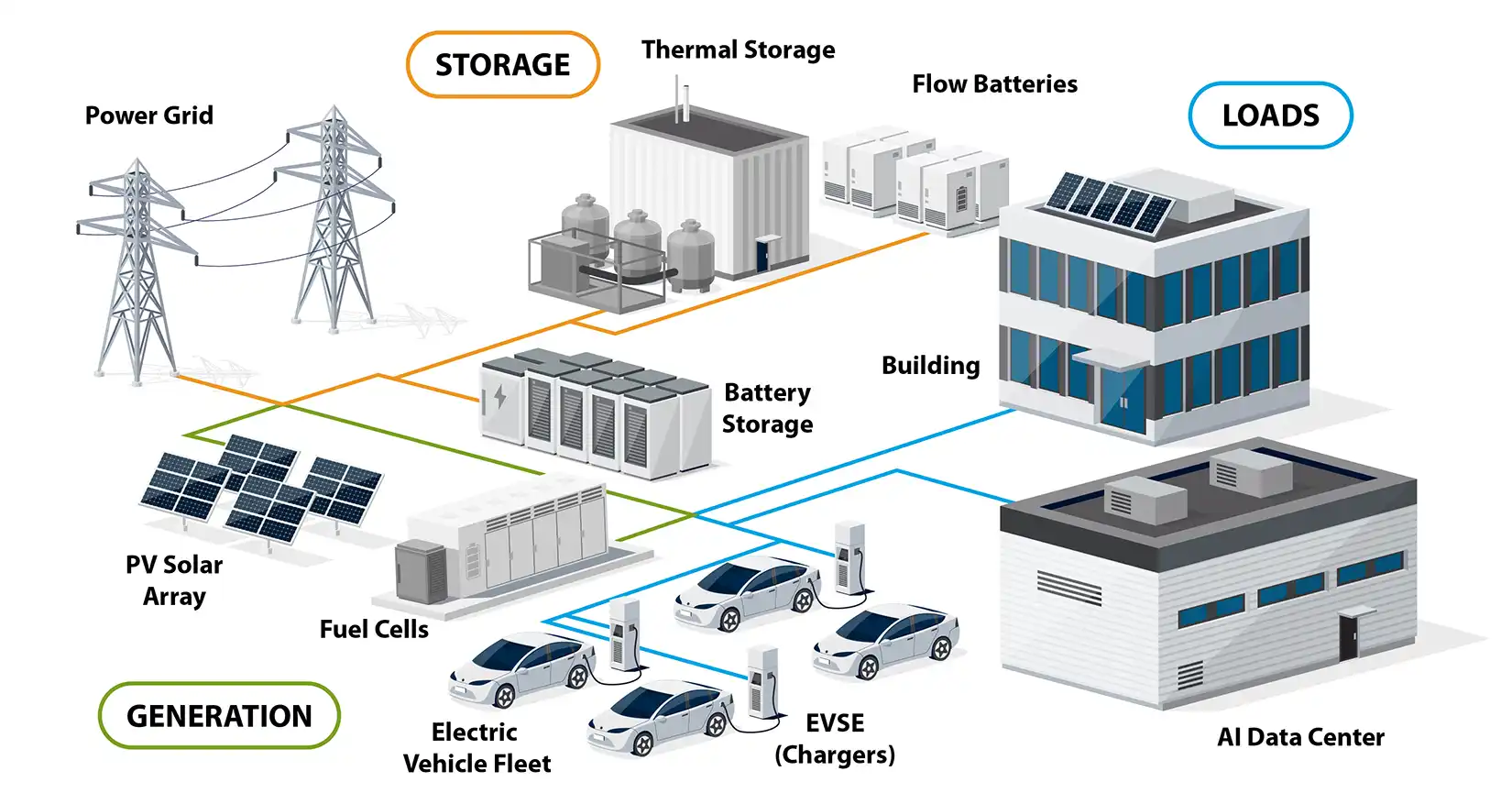
A microgrid illustration with example storage, generation, and load elements. Graphic by Cameron Nelson, National Laboratory of the Rockies
Why EDGES Is Relevant Today
Growth in data-intensive computing, connected transportation, and other high-power applications is increasing pressure on local distribution infrastructure and behind-the-meter system design. In these contexts, operational feasibility and service continuity increasingly determine project viability. EDGES provides a structured framework for evaluating these challenges by linking design, dispatch, and operational constraints within a unified modeling environment.
To accurately model these emerging threats to grid stability, EDGES integrates dynamic energy profiles driven by actual artificial intelligence workloads and user behavior—a framework validated in the recent arXiv preprint, Measurement of Generative AI Workload Power Profiles for Whole-Facility Data Center Infrastructure Planning.
Publications
Behind-the-Meter Energy Storage and Generation in Support of Electrified Rental Car Centers , IEEE Electrical Energy Storage Applications and Technologies Conference (2025)
Impact of Load Uncertainty From Electrified Rental Car Facilities on the Control and Design of Behind-the-Meter Battery Storage and PV Generation , American Control Conference (2025)
Levelized Cost of Charging of Extreme Fast Charging With Stationary LMO/LTO Batteries , Journal of Energy Storage (2024)
Contact
For more information about EDGES and ongoing applications, please contact the EDGES modeling team.
Share

Last Updated June 5, 2026