
Grid-Interactive Buildings
Buildings-to-grid research at the Energy Systems Integration Facility (ESIF) targets solutions to improve the interaction between the building and the grid.
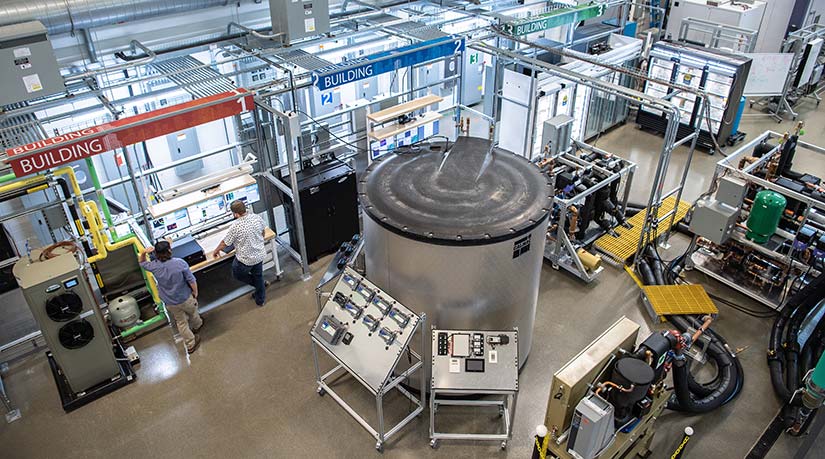
The ESIF provides researchers with the unique capability to emulate any grid scenario at the megawatt scale. Scientists use this power to explore how to better connect utilities, buildings, and the grid, harnessing load flexibility, automated energy management systems, energy storage, and other solutions. Similarly, industry members work with us to develop and evaluate new control systems before they are installed in real buildings.
The ESIF Advantage
Commercial Buildings Research Infrastructure
NLR's Commercial Buildings Research Infrastructure is critical to determining how commercial grid-interactive efficient buildings can provide load flexibility for the grid. Buildings-to-grid research in this space targets solutions to minimize energy consumption while improving grid resilience.
Environmental Chambers
Environmental chambers can mimic any indoor or outdoor environment with the precise simulation of temperature and humidity. Technologies can be validated in varied conditions, mimicking anything from a grocery store in Florida to a bank in Alaska. Partners can evaluate heating and cooling equipment, dehumidification systems, refrigerators and freezers, and water heaters up to 20 tons. This space is also suited for evaluating data center technologies such as server racks, processors, and computer chips.
Residential Research Infrastructure
In the Systems Performance Laboratory, three research homes equipped with major appliances and other typical loads allow for the evaluation of connected appliances, advanced sensors and controls, and home energy management systems. Each home has connections for 120/240 volts of electric service, water, and natural gas—with distribution transformers that allow the homes to be connected and evaluated as a miniature neighborhood. With hardware-in-the-loop evaluation capabilities, researchers can implement hardware controls on residential loads in the lab and simulate its impact on distributed energy generation.
Learn about NLR's Buildings Research Program and contributions to the Behind-the-Meter Storage Consortium, which is developing energy storage technologies for the grid through grid-interactive buildings and vehicles.
Contacts
Grant Wheeler
Researcher, Commercial Buildings Research Infrastructure
Share

Last Updated Feb. 20, 2026