
Facility Infrastructure
Unique, world-class research system infrastructure allows the Energy Systems Integration Facility (ESIF) to provide integrated research capabilities for major energy systems.
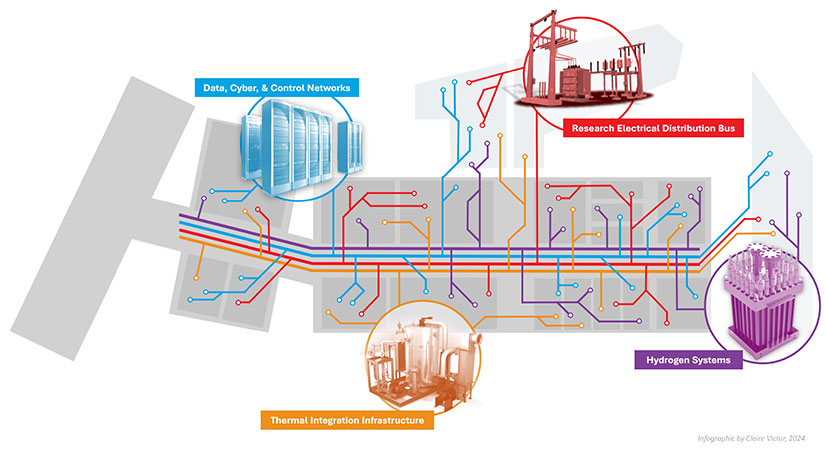
Energy Data, Cyber, and Controls Networks
The ESIF's research data networks pervade its energy systems and capabilities to create a unique and powerful installation that keeps energy research running. This infrastructure supports the confluence of big energy data, high-performance computing, real-time computing, operational technology networks, and cybersecurity. High-bandwidth communications allow for connectivity between the ESIF and NLR's Flatirons Campus as well as access for remotely connected partners. Built from fiber, Ethernet, wireless communications, and industrial data servers, this important technology layer ties together the facility's unique research capabilities.
Electrical Distribution
The research electrical distribution bus system—the heart of the ESIF's electrical system evaluation capability—facilitates power flow among various grid and experimental equipment in a research microgrid arrangement. The system supports AC (up to 13.2 kV) and DC (1,000 V) power flow exceeding 1 MW and is managed by a tailored supervisory control and data acquisition interface. The systems deliver wider grid integration capabilities with real power hardware as well as microgrid and localized power system setups from residential to industrial scales. Designed to maximize flexibility while minimizing risks, the electrical distribution bus system allows researchers to advance the engineering of electronic and grid devices such as inverters, protection, sensors, large loads, instruments, converters, machines, and control systems.
Hydrogen Systems
The ESIF's hydrogen systems capabilities span energy sectors by supporting research on large industrial loads, backup power, energy storage, grid hardening, molecule synthesis, and transportation. These systems—hydrogen production, power delivery, compression, storage and delivery—demonstrate the flexibility of hydrogen energy integration technology for modern applications. Hydrogen production from electrolysis provides the foundation for systems research in biomethanation and other chemical processes that create useful industrial products.
Thermal Integration Infrastructure
The ESIF's integrated thermal distribution systems consist of hot- and cold-water loops connected to a boiler and chiller that provide precise and efficient control of the water temperature delivered to laboratories. The thermal distribution bus allows researchers to study and characterize industrial cooling, heating, ventilating, and air-conditioning systems as well as combined heat and power applications. Thermal real-time simulation leverages these systems to create complex, real-world thermal integration scenarios.
Learn more about the ESIF's unique research capabilities.
Share

Last Updated May 29, 2026