
Aim 4—Interface Characterization
APEX works to understand and control interfacial phases, reactions, and evolution to further the science for performance, stability, and resilience of power electronics materials.
Goals and Potential Impact
Power electronics are critical components in delivering a future grid design that can nimbly handle higher power loads from intermittent and distributed sources. But given increasingly demanding operating requirements, they may also be one of the potential weakest links. In an ideal world, these materials, devices, interfaces, and packages would be able to withstand high temperatures (~400°C), higher voltages (~ up to 50 kV), and higher power densities (~ up to 1000 W/cm2), well beyond what is achievable today. At all parts of the stack in power electronic devices, it is the interface where most of the losses occur, resulting in thermal buildup, decreased performance, and a breakdown in resilience.
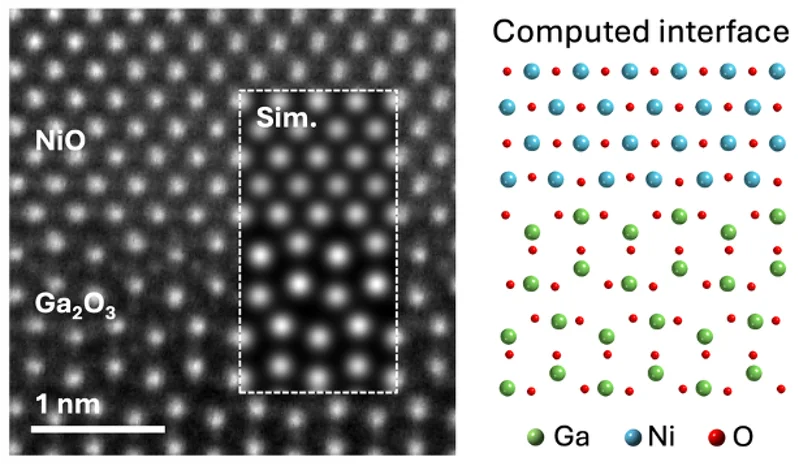
Aim 4 addresses life cycle and resilience challenges at the heterogeneous interfaces through state-of-the-art nanoscale correlated characterization of structural, electronic, and thermal properties. The focus of Aim 4 is to characterize interphases with high spatial, chemical, spectral, and temporal resolution, providing knowledge and feedback to guide predictive control over synthesis products and device performance (see figure).
Science Questions
When two materials are brought into contact, the interface is rarely abrupt but instead occupies a finite spatial dimension up to several nanometers thick, depending on synthesis conditions. This region can be structurally, chemically, and electronically distinct and remarkably different depending on the stacking order. This is particularly true for the interface between dissimilar materials. Therefore, it is vital to identify and study the interphases that actually form and observe how they evolve. This provides a framework to understand and control synthesis, mitigate degradation, and increase the life cycle of resulting devices.
Overarching scientific questions are:
What are the interphases that form between dissimilar materials for a given set of synthesis conditions?
How do we tailor the electrical and thermal properties at the interphase (based on the defects and electronic and phononic interface properties) for superior performance?
What is the subsequent environmental evolution of the interphase?
Contact
For more information about the research in Aim 4 or to discuss potential collaboration, please contact Steven Spurgeon at NLR.
Share

Last Updated Oct. 13, 2026