
Nov. 11, 2026 | By Erik F. Ringle | Contact media relations

The bioenergy and bioeconomy program at the U.S. Department of Energy's (DOE's) National Laboratory of the Rockies (NLR) owns more than a little experimental data—it has lots of it. The data trail stretches back more than 45 years.
Since 1979, the program has yielded more than 3,600 peer-reviewed articles, reports, and book chapters on topics ranging from biomass characterization to thermochemical processing, synthetic biology, scale-up science, and beyond.
Each publication represents a step forward in science. And each records data points that measure something important: product yield, mass balance, off-gas, pH, or some other specific parameter.
In 2026, with the launch of DOE's Genesis Mission and improvements in fundamental super intelligence models, meticulously organizing and collecting scientific data has only grown in importance.
Commercial chatbots trained on the corpus of the English language can suggest ways to complete a sentence in the blink of an eye. Similarly, super intelligence tools trained on high-quality scientific data can help researchers solve complex problems, whether that is completing a task more quickly, making predictions, or uncovering connections that might otherwise remain hidden across a body of knowledge.
If it sounds like magic, it is not. Successfully applying super intelligence to a scientific problem ultimately starts with a hard look at the data—both what is available and what is not.
Given a large language model trained on a sufficient volume of curated, high-quality scientific data—and encoded with "instructions" on how to query those data, supplement with third-party tools, and format responses—NLR researchers can improve their scientific workflows and move insights to industry.
"Available biological and bioprocessing data is uneven today," NLR applied mathematician Juliane Mueller explained. "In some domains—protein engineering, for instance—researchers can now draw on thousands of consistent, structured data points, albeit at small scale, enough to train and validate predictive models directly. In others, like pilot- and industrial-scale bioprocessing, high-quality large-scale data remain scarce."
This unevenness in scientific data is not necessarily a liability for super intelligence-guided research, Mueller said. In fact, the super intelligence tools themselves open doors for making connections where data are sparse or when missing metadata make old data unusable.
"These tools offer a way to make the most of a mixed data landscape," she explained. "We can leverage dense datasets where they exist and use synthetic and multifidelity approaches to responsibly extend the reach of the data where they don't."
What changes to an amino acid sequence could give a protein a new attribute? What genetic modifications might make a microbe tolerate lower oxygen levels? What unforeseen circumstances could cause a new biorefinery to fail or costs to balloon?
Mueller and other NLR researchers are building super intelligence tools that suggest answers to those questions—answers that could offer tangible benefits for industry.
How exactly? Consider three examples: de-risking biorefinery scale-up, matchmaking microbes with bioreactors, and predicting the best protein designs for critical mineral extraction and other applications.
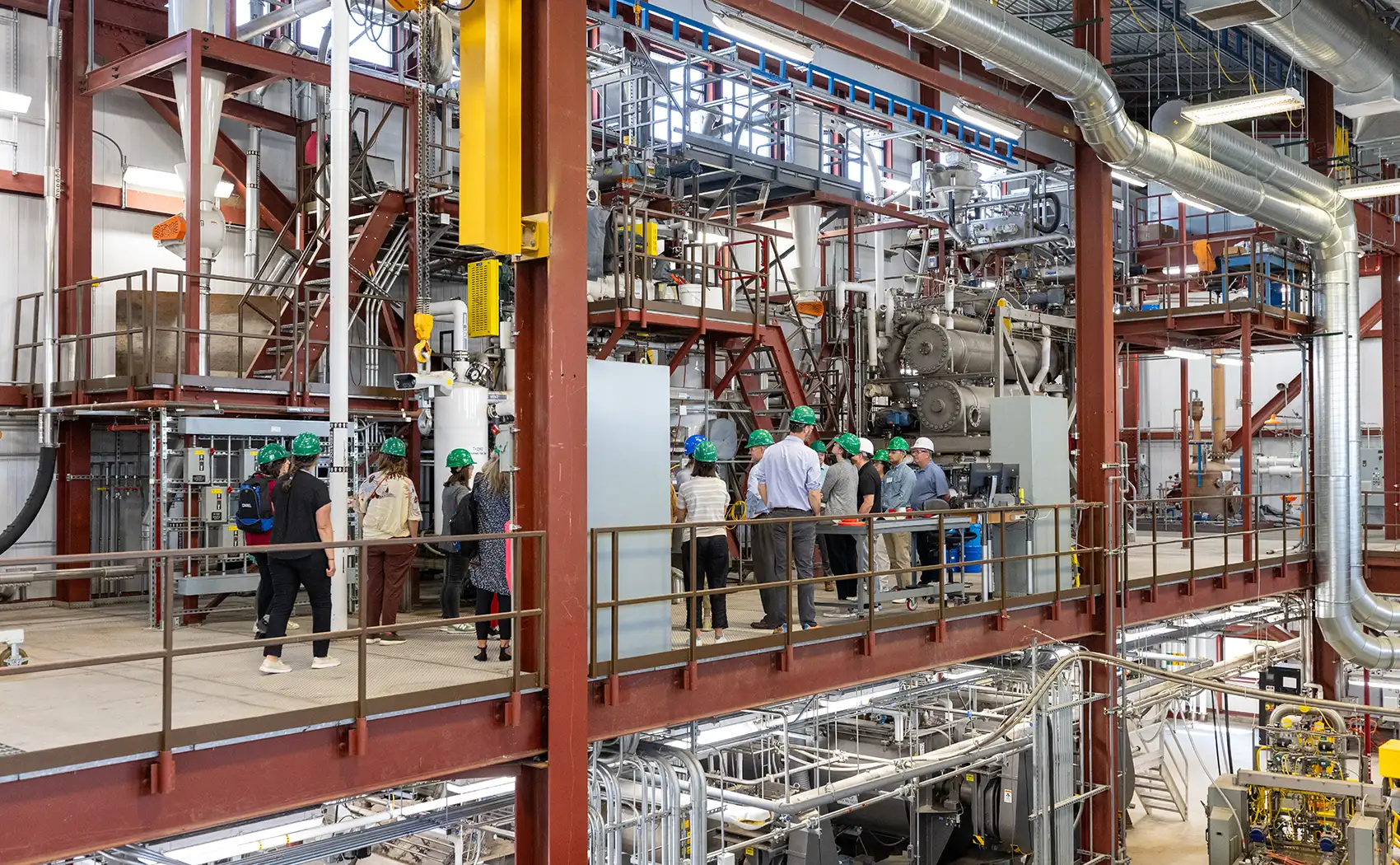
Use Case 1: Predicting What Could Fail in a New Biorefinery
As much as 175 million tons of agricultural residue could be collected from across the United States every year as resources for making bio-based chemicals, materials, and fuels, according to DOE's national biomass resource study, the Billion-Ton report. But commercializing second-generation ethanol refineries—those capable of processing such tough, fibrous agricultural waste—is technically challenging, according to Zia Abdullah, a laboratory program manager at NLR.
"Many cellulosic biorefineries over the years have faced difficulties because of challenges inherent to scaling up and integrating their technologies up to commercial operations," Abdullah said. "But those failures have provided learnings and data, which, along with bench-scale and pilot-scale data, we are using to train a tool to help industry avoid similar mistakes in the future."
In collaboration with Idaho National Laboratory (INL) and Lawrence Berkeley National Laboratory (LBNL), NLR is developing a reasoning super intelligence tool to help industry predict "failure mechanisms" before they invest millions of dollars to scale up a new process.
Training Data:
NLR, INL, and LBNL experimental data
Subject matter expert interviews
Synthetic data from first-principles models.
Dataset Sizes: Tens of data points to thousands of data points.
Potential Impact for Industry: Ability to predict what could fail in a new biorefinery before investing millions of dollars.
NLR Project Lead: Zia Abdullah
"The goal is to create a super intelligence model that can reason through potential failure modes using the bench-scale, pilot-scale, and available commercial-scale data; additional synthetic data produced from first-principles mechanistic models; literature; and expert opinion," Abdullah explained.
To begin, the team is building data-driven surrogate models of every process step of converting corn stover into alcohol—drawing heavily from data collected from INL's Biomass Feedstock National User Facility, LBNL's Advanced BioProcess Development Unit, and NLR's special-purpose laboratories and biochemical pilot plant in its Integrated Biorefinery Research Facility. Because data for this specific application at bench and pilot scales are scarce, NLR is augmenting them with synthetic data from first-principles mechanistic models.
With the help of Mueller and her team, Abdullah and the project team are connecting those discrete, data-driven surrogate models into a super intelligence-driven decision support tool designed to reason through process design with a user. First, an industry engineer may enter a prompt, such as providing scenarios and ideas for a new biorefinery design. The super intelligence agent then draws from its training and relevant supporting data to respond to the technical information. It comments on various unit operations in a biorefinery, including feedstock processing, acid pretreatment, enzymatic hydrolysis, and fermentation to final products, and provides qualitative and quantitative information.
When Experimental Data Are Not Enough
NLR modeling and analysis experts are using Kestrel, NLR's 56-petaflop supercomputer, to generate super-intelligence-ready "synthetic data" from physics principles, which fill gaps in experimental data. Photo by Agata Bogucka, National Laboratory of the Rockies
"Will there be too much hydrostatic pressure at the bottom of a tank? What will happen if I scale up this process by a factor of 1,000? What if my biomass has been sitting out in the rain for six months? What happens if I increase process intensity so that I can increase production from my facility? These are the kind of scenarios our super intelligence agent will be able to reason through with the user," Abdullah said.
Currently, the model (developed with support from DOE's Alternative Fuels and Feedstocks Office) is slated to be complete by 2029. Once completed and validated, Abdullah expects the super intelligence agent to be available for licensing to industry and other stakeholders.
Use Case 2: Matchmaking Microbes With Industrial-Scale Fermentation Tanks
Among the 200 biorefineries that dot the country, most make ethanol. They use giant steel stirred-tank bioreactors—filled with microbes—to ferment sugar extracted from corn kernels into alcohol.
But industry is increasingly interested in making more than ethanol. Can companies use those same steel bioreactors to turn sugar into a wider slate of chemicals, be it ethylene for plastics or muconic acid for nylon?
Lab-scale studies using small bioreactors have proved the answer is "yes." According to one study published in Joule, different microbes can quite easily ferment sugar into a wide range of useful products.
But, as NLR fermentation researcher and group manager Davinia Salvachúa Rodríguez knows, that is not always the case when you put those same microbes into larger bioreactors at existing ethanol plants.
Training Data:
Scientific literature
New NLR experimental data
Computationally generated synthetic data.
Dataset Sizes: Thousands of data points.
Potential Impact for Industry: Anticipate microbial performance during the production of chemicals in existing or newly designed biorefinery equipment.
NLR Project Lead: Davinia Salvachúa Rodríguez
"We have seen that, for some fermentations, bench-scale results are not reproducible when scaling up. Productivity decreases," she said. "This negatively impacts the economics of bioprocesses."
A potential reason for this, Salvachúa explained, is because microbial populations crash due to "microenvironments" in the larger tanks. The mixing process creates pockets of widely different pH, pressure, or oxygen levels—pockets not observed in the bench-sized reactors in NLR's fermentation laboratories.
With funding from DOE's Office of Science Biological and Environmental Research program, Salvachúa is leading a large multi-institutional team to develop a machine- learning (ML) tool that helps them identify these microenvironments and give industry the ability to anticipate how detrimental they will be for their specific microbes. The team is also studying how microbes respond to stresses they may encounter in large bioreactors, so they might ultimately improve their genomes and weather them better.
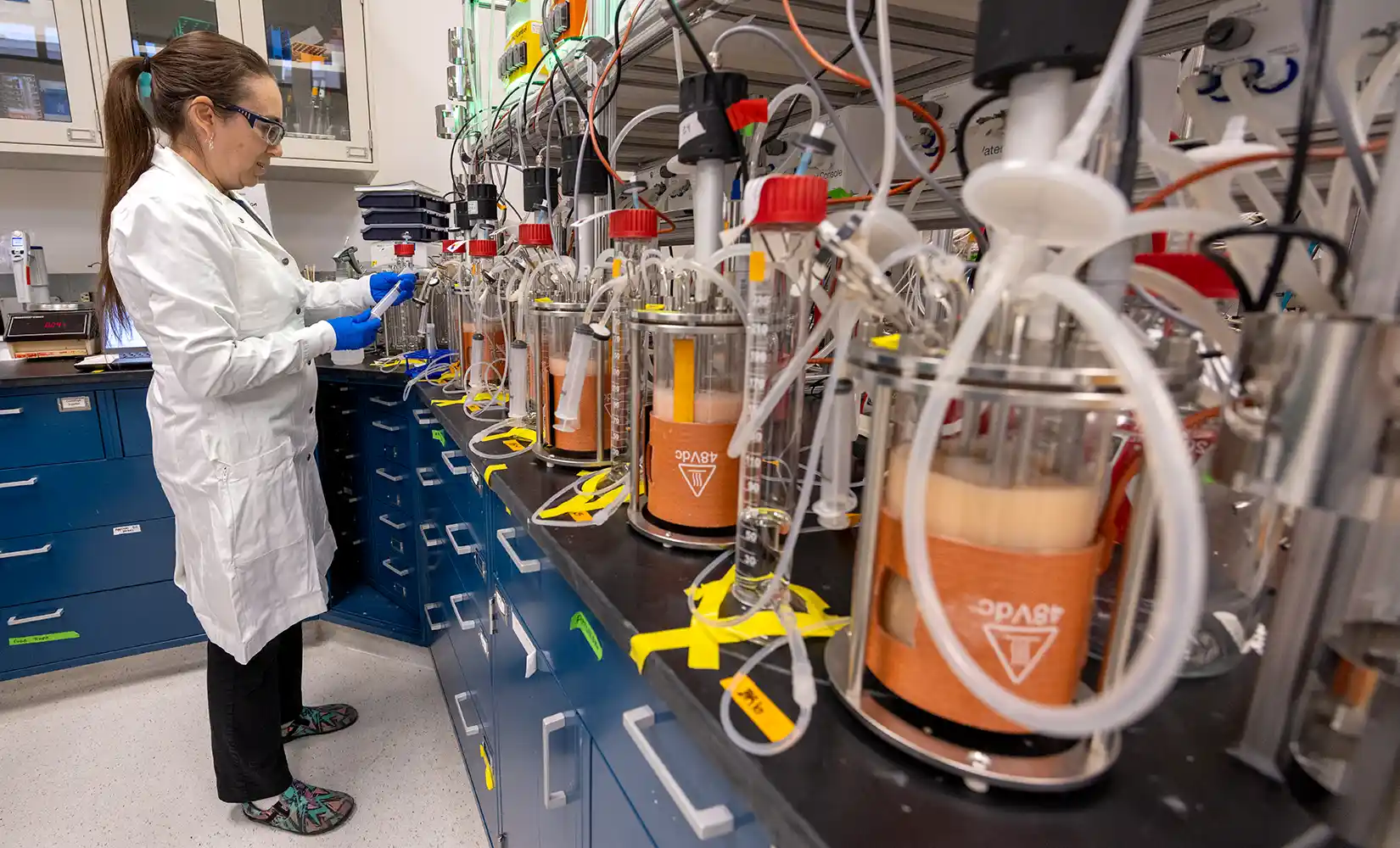
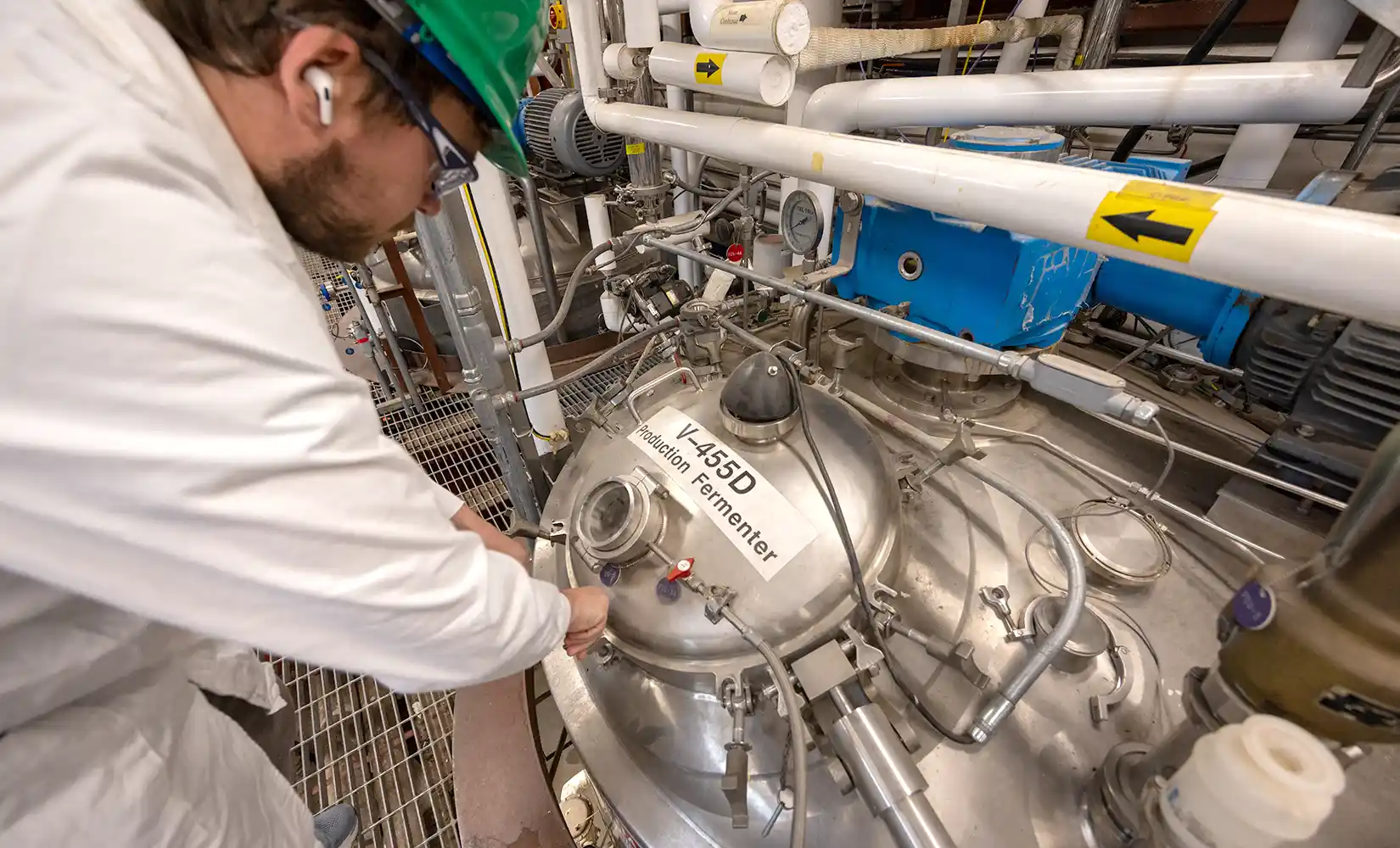
NLR researcher Christine Singer (left) takes a sample from a 1-liter bioreactor in one of NLR's two fermentation laboratories. Experimental data from studies at this scale help train a machine learning tool to predict microbe behavior in much larger bioreactors, such as in the 9,000-liter fermentation tank that William Cordell adjusts down the hall in NLR's Biomass Conversion Pilot Plant (right).
"Some companies cannot change the bioreactors they already have at industrial facilities, but they can improve the strengths of the microbes they put in them," Salvachúa said. "We want to deliver a tool to help them do this, so we are using super intelligence to combine the entire genome-scale model of the microbes with the physics of the bioreactor to predict and ultimately improve microbial performance."
With this approach in mind, NLR computational scientists like Hariswaran Sitaraman are creating physical representations of industrial bioreactors. Meanwhile, Mueller and other super intelligence experts are building ML models that learn from both those physical models and biological models of microbes, the latter generated at the University of California, San Diego. Then, biologists at NLR and Pacific Northwest National Laboratory collect data through computationally guided studies to evaluate microbial metabolism, such as gene expression and protein production.
"What we are doing is mimicking those heterogeneities from the large-scale bioreactor," Salvachúa explained. "If we predict there is going to be low pH or low oxygen, we replicate that in our small bioreactor. We are generating a lot of data, and we will feed it to our super intelligence tool."
The result is a super intelligence workflow—trained on genomic-scale models, computational fluid dynamics, and experimental data—that enables the team to predict microbe performance and designs to produce high chemical yields even in the complex environment of an industrial-size fermenter.
Use Case 3: Suggesting Protein Designs for Industry Applications
It has been four short years since the release of AlphaFold, a tool reportedly capable of mapping the entire protein universe using super intelligence. Since then, that ability to use super intelligence to predict and visualize protein structures has changed how many biochemists and biological engineers approach their work.
NLR researchers are using super intelligence to screen thousands of proteins for use in industry applications, such as the proteins pictured here that form strong bonds with specific rare earth metals. Figure by Peter Ciesielski, National Laboratory of the Rockies
With the seemingly limitless protein universe at their fingertips, NLR researchers from a range of disciplines are now using super intelligence to narrow their search for the best proteins for a variety of biotechnologies.

"These models are trained on all protein sequences that are available, so they capture the underlying structural and functional constraints and featurization of the natural protein space. Here at NLR, our projects build on these models, because they help us predict single amino acid changes."
Jeffrey Law, NLR computational biologist
Training Data:
Data extracted from scientific literature
NLR experimental data
Data from simulations.
Dataset Sizes: Tens of data points to tens of thousands of data points, potentially expanding to millions as more simulations are run.
Potential Impact for Industry: Custom proteins for mineral separations, biosensing, cell-free biomanufacturing, anaerobic digestion, plastics recycling, and more.
NLR Project Leads:
Steve Decker (anaerobic digestion)
Gregg Beckham (plastics recycling)
Yannick Bomble (cell-free biomanufacturing)
Alli Werner (critical minerals)
Amino acids are the building blocks of proteins, so even subtle changes to their molecular structure can significantly alter a protein's structure and function, giving it useful capabilities it did not have before. For example, NLR researchers modify amino acid sequences to customize proteins that bind to specific metals, which industry might use to extract critical minerals from mine tailings or other complex feedstocks. Others are engineering proteins for plastic recycling and cell-free biomanufacturing.
The advantage is speed.
"Within minutes to hours we are able to give geneticists really high probability of proteins that will actually work," NLR physicist John Yarbrough added. "So that should cut their experiment time significantly."
Like Law, Yarborough supports ML-guided efforts for all kinds of applied bioprocessing research, including ongoing work to identify protein structures that tolerate higher-salt-concentration environments.
"We mined existing datasets on halotolerant proteins as well as datasets on proteins present in high-salt environments, like from down deep in the ocean," he explained. "We then used that data to train a model that recommends point mutations to make them perform better in industry anaerobic digesters."
Law uses a similar workflow to predict proteins that do not break down when exposed to high temperatures or high pH—key attributes for proteins used in cell-free biomanufacturing systems. The ML model downselects from a list of protein designs predicted to have certain attributes. Law and his collaborators then perform lab experiments—like kinetics measurements or assays—to verify if those predictions are correct. Do the proteins perform as well as super intelligence predicted they would?
All About Speed
Biologist Sam Mallinson loads an automated microplate stacker connected to a multimode microplate reader, which rapidly characterizes protein samples. The data gathered in NLR's protein purification and characterization labs enables researchers to train ML models designed to flag promising proteins for further analysis and testing. Photo by Joe DelNero, National Laboratory of the Rockies
"That often leads to multiple rounds of active learning," Law explained. "Experiments may show that some proteins didn't end up having a strong effect but others did. We incorporate that back into the training data, and we continue to iterate and improve."
Train, predict, experiment, repeat. That iterative process could yield impactful experimental results more quickly, as well as more accurate super intelligence predictions. For example, NLR protein researchers use automated liquid-handling robots that can sample and characterize hundreds or even thousands of proteins in a single day. Yarbrough's and Law's ML models use these growing protein libraries as training data, which researchers ultimately call upon to predict and visualize protein designs.
"The field is advancing at a remarkable pace," Law said. "It's not just new tools and approaches for enzyme design—super intelligence agents can now help set up and analyze high-throughput simulations and build and train ML models, helping speed up almost every part of the pipeline."
How Can NLR's Super Intelligence Approaches Benefit Your Bioprocess?
Learn how to partner with NLR to develop, translate, and de-risk bioeconomy innovations. And explore NLR's bioenergy and bioeconomy research, including its analysis, characterization, modeling, and super intelligence research.
Share
Last Updated Nov. 11, 2026