
Biomass Conversion Pilot Plant
NLR's Biomass Conversion Pilot Plant enables researchers, industry partners, and stakeholders to test a variety of integrated, performance-enhanced chemical conversion processes and technologies.
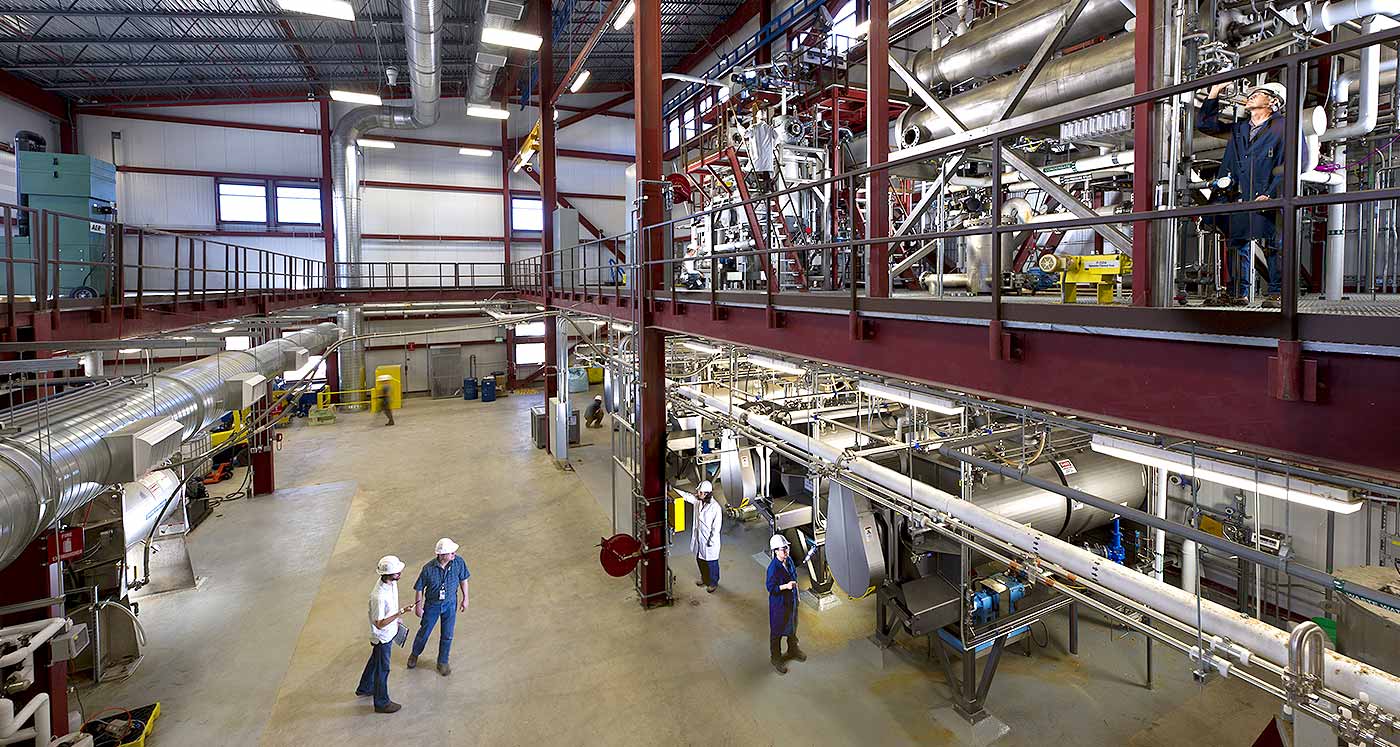
NLR's 27,000-ft2 high-bay Biomass Conversion Pilot Plant accommodates bench-to-pilot-scale processes for converting cellulosic biomass into a variety of chemicals and fuels at process throughputs of up to 1 tonne of dry biomass per day.
Experiments in the Biomass Conversion Pilot Plant are supported by NLR's technological scale-up and piloting research. NLR's analysis, characterization, modeling, and artificial intelligence research helps accelerate the translation of laboratory-scale conversion pathways to commercial-scale production.
Revitalization Effort
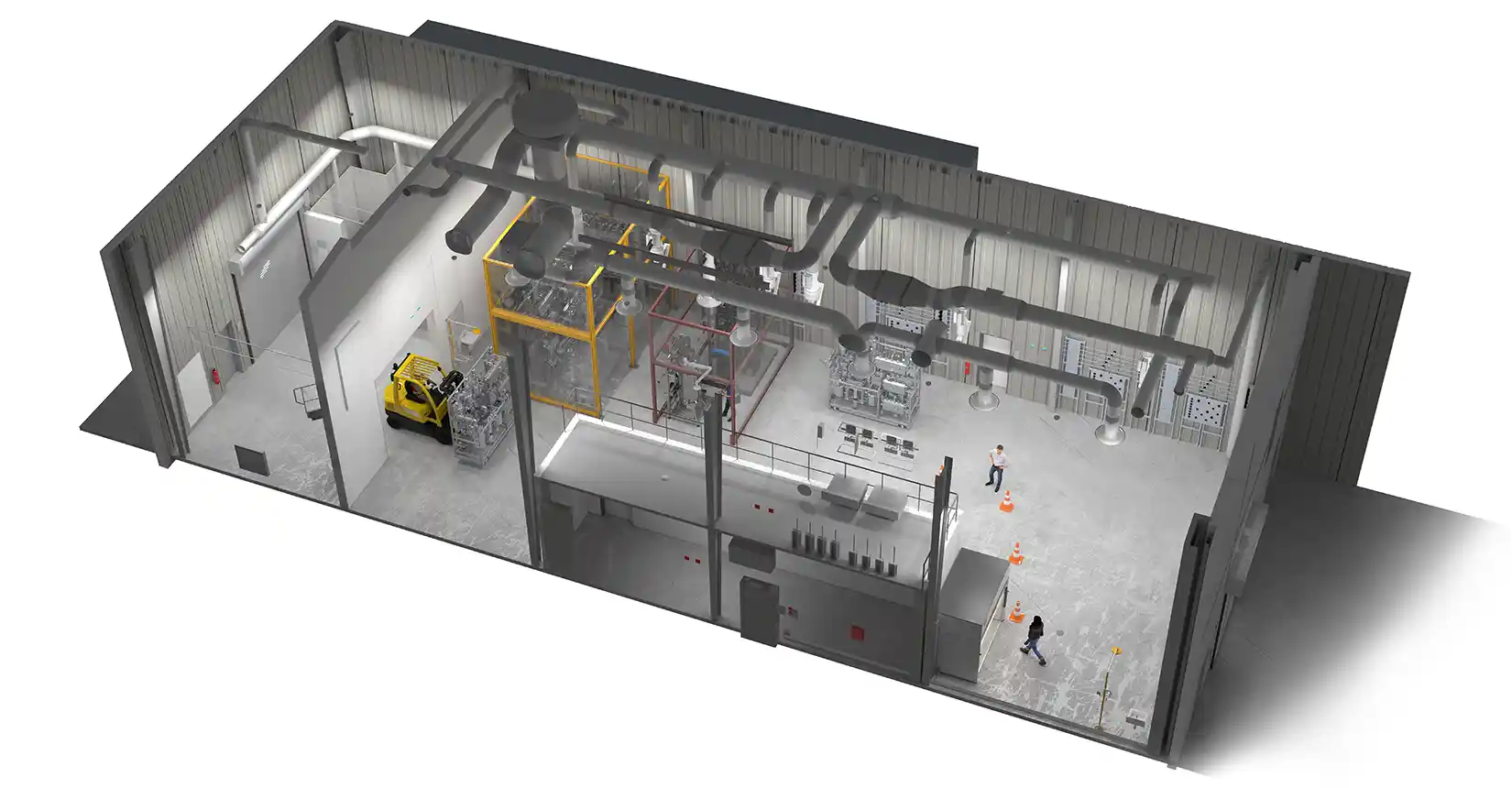
Since its design and construction in the mid-1990s, NLR's Integrated Biorefinery Research Facility has been a significant asset to the U.S. Department of Energy in building valuable R&D partnerships across the bioeconomy. Now, to meet the challenges of developing the next generation of chemical, fertilizer, and critical mineral technologies, NLR is modernizing the facility.
Key upgrades to the Integrated Biorefinery Research Facility Biomass Conversion Pilot Plant enable cost-effective, timely, and technically rigorous piloting to enable:
Plug-and-play modular concepts for rapid reconfiguration and integration of new and existing equipment to reduce costs
Full process integration from feedstock to finished products at Technology Readiness Level 5/6, incorporating biochemical, thermochemical, and electrochemical equipment
Rigorous analytics and data tracking using highly instrumented systems to allow for deep understanding of process
Comprehensive modeling—including digital twin, computational fluid dynamics and techno-economic and process analysis—to accurately simulate and derisk technologies
Scale-up lessons and support with experienced and dedicated personnel to ensure high integrity data
Quicker paths to commercialization through equipment and utilities that minimize technology scale-up barriers.
Together, these enhancements significantly boost the facility's flexibility, speed, safety, scale-up, and piloting capabilities. These capabilities will accommodate biochemical, thermochemical, and electrochemical research from bench-scale to pilot-scale for decades to come.
Core Capabilities
NLR's Biomass Conversion Pilot Plant includes the following capabilities:
Storage area for feedstock delivered in totes, drums, or supersacks
Smaller mobile knife mill for smaller sample preparations
PFI mill batch pulping for 20–40 grams dry basis
Two 100 dry kg per hour knife milling systems with dust collection
Mobile 12" disc refiner with manual plate gap adjustment at .025 mm increments
Mobile planetary ring-roller mill used for both wet and dry grinding
Feed surge hoppers and pneumatic conveyance to pretreatment systems and cyclones for milled product collection
1-L stirred batch reactor
4-L steam-explosion batch reactor, maximum temperature is 238°C at 450 psig saturated steam pressure (reactor is fabricated from Hastelloy C-22)
90-L batch paddle-type mixed reactor (Alloy 20 construction) (90 psig MAWP)
170-L batch paddle-type mixed reactor (Hastelloy C-22 construction) (350 psig MAWP)
Continuous horizontal screw-type reactor system with 4 auger reactors in series, capacity of 0.5 tonnes per 24-hour day of dry biomass (140°C–210°C and 3–120-minute residence times) (reactor tubes are fabricated from 316 stainless steel and Hastelloy)
Continuous vertical reactor, capacity of 0.5–1 tonne per 24-hour day of dry biomass capacity (140°C–210°C and 2–60-minute residence times), with an inline secondary reactor for optional treatment at lower temperatures (reactor tubes are fabricated from Hastelloy C-2000 and 316 stainless steel)
All reactor systems have multiple options for pretreatment catalysts
30-L batch or continuous paddle-type mixed reactor (316 stainless steel construction) (100 psig MAWP)
1,900-L batch paddle-type mixed reactor (316L stainless steel construction) (50 psig MAWP) with hot-water jacket
Four 4,000-L hot-water jacketed paddle reactors for semi-continuous processing at total solids loadings greater than 20% (w/w) (constructed of 304 stainless steel)
Pilot plant bioreactors that can be ran independently or sequentially consisting of two 160-L fermentation vessels, two 1,500-L fermentation vessels, and four 9,000-L fermentation vessels
All vessels can be operated in batch, fed-batch, or continuous mode of operation
Fully instrumented (pressure, temperature, pH, weight [level], dissolved oxygen) and controlled bioreactors at various scales
Off-gas monitoring with mass-spec
Capability of aerobic or anaerobic operation
316 Stainless steel (MAWP of 50 psig/Full Vacuum)
Agitated (two impellers per tank) and aerated
Clean-in-place installed on all bioreactors
Continuous high-temperature, short-residence-time sterilizer
Perforated basket filtering centrifuge 120-L bowl, Hastelloy construction, 900 g's
Perforated basket filtering centrifuge 320-L bowl, 316 stainless steel construction, 900 g's
Disc stack centrifuge typically used for microbial cell separation, continuous operation capable of both two-phase or three-phase separations, 316 stainless steel, 11,000 g's
Horizontal solid bowl centrifuge designed for continuous high-g force separation of industrial slurries into liquid and solid phases, 304 stainless steel
Cross flow filtration currently configured for microfiltration, 18,000 liter/hour circulation rate, 1–3 liter/minute permeate rate depending on feed characteristics, 316 stainless steel construction
Forced circulation evaporator with continuous feed capabilities handling insoluble solids up to 5 wt percent biomass, 500 lb/h water evaporation rate, 304 stainless steel construction, 75 psig MAWP
Bench- and pilot-scale biomass chemical impregnation and dewatering systems (screw presses)
Research in the Biomass Conversion Pilot Plant taps into NLR's suite of special-purpose laboratories, including:
Compositional analysis
Process engineering and economic analysis
Molecular biology
Microscopy analysis
Rheology and particle size characterization
High-throughput processing and analysis
Computational modeling.
Contact
Work With Us
Learn how to work with NLR to develop, translate, and de-risk bioeconomy innovations for market readiness.
Share

Last Updated Oct. 16, 2026