
Analytical Laboratories
NLR's special-purpose analytical laboratories enable a range of analyses and characterization studies on feedstocks, biocatalysts, molecules, and biological structures.
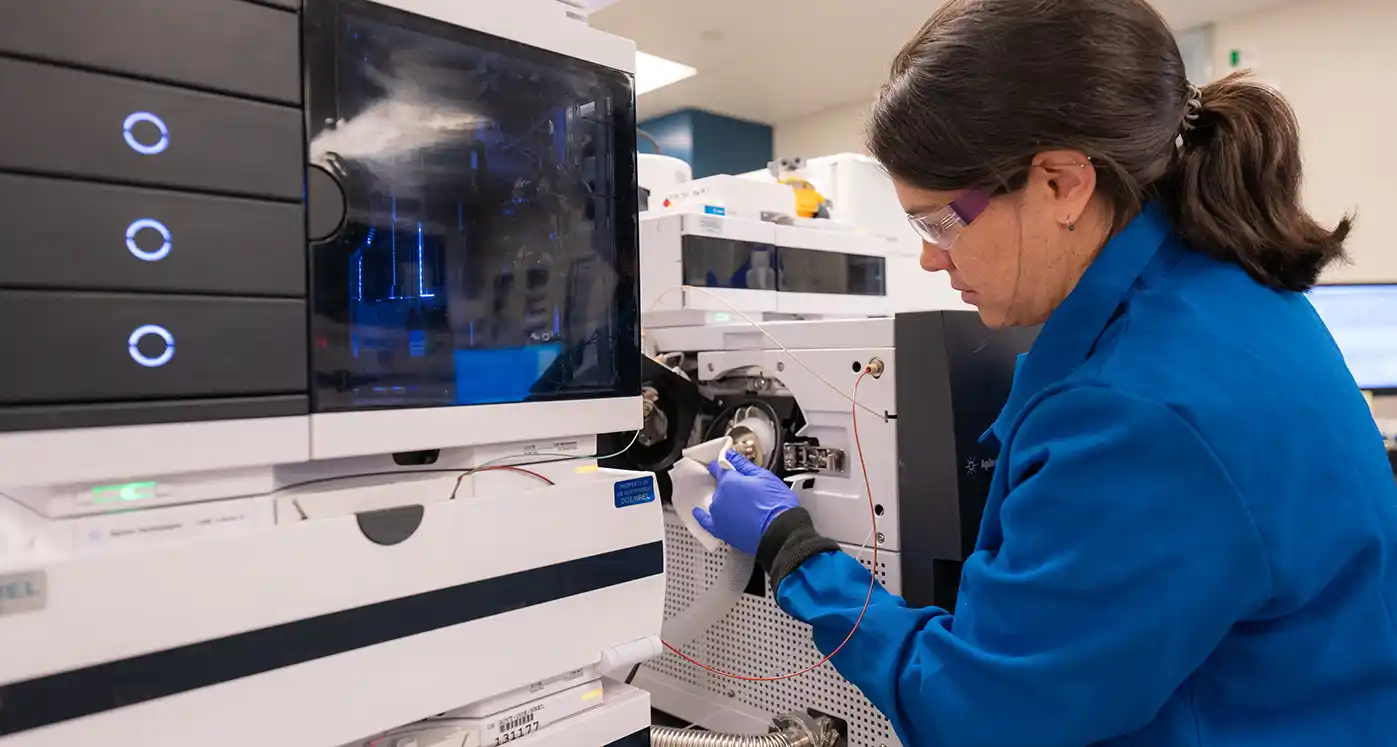
NLR's Advanced Analytical Laboratory provides state-of-the-art instrumental analysis capabilities to identify and quantify a variety of molecules, supporting NLR researchers in disciplines including biology, polymers, chemistry, and materials science.
Capabilities include gas and liquid chromatography systems with conventional and mass spectrometry detectors as well as high-resolution mass spectrometry instrumentation.
Contact
Ed Wolfrum
Principal Researcher and Manager
Ed.Wolfrum@nlr.gov
NLR's Advanced Spin Resonance Facility includes two Bruker electron paramagnetic resonance spectrometers equipped with multifrequency, continuous-wave, advanced-pulsed, and on-demand cryogenic capabilities.
Contact
Paul King
Group Manager
Paul.King@nlr.gov
The Biomass Compositional Analysis Laboratories include wet chemical and analytical instrumentation necessary to support the detailed characterization of biomass feedstocks, process intermediates, and bio-derived fermentation products.
The laboratories contain standard equipment such as balances, drying ovens, and furnaces along with comprehensive liquid and gas chromatography (high-performance liquid chromatography and gas chromatography) and instrumentation.
In addition, the laboratories contain multiple near-infrared spectrometers that, in some cases, can provide rapid characterization of biomass feedstocks and process intermediates based on advanced multivariate statistical models. Some of these models are available for licensing.
Contact
Ed Wolfrum
Principal Researcher and Manager
Ed.Wolfrum@nlr.gov
NLR uses electron microscopy to directly visualize materials from the microscale down to the atomic scale. This powerful technique uses a beam of electrons to generate site-specific information from a sample, allowing researchers to study the morphology,
microstructure, and chemical composition of materials with high spatial resolution.
NLR's Biosciences Structural Characterization Laboratory houses capabilities for scanning electron microscopy and transmission electron microscopy.
- Scanning electron microscopy tools and techniques allow for routine and powerful analytical experiments to be conducted on a range of energy materials. Scanning electron microscopy tools scan a high-energy (0.1–30-keV) beam of electrons across
a sample, generating a variety of interactions and characteristic signals. Some of these signals include secondary electrons and backscattered electrons for different methods of imaging, and X-rays for energy-dispersive X-ray spectroscopy.
- Transmission electron microscopy (TEM) allows for the study of samples down to the atomic scale and comes in two varieties. Conventional TEM passes a beam of electrons through extremely thin specimens to generate data, while scanning TEM focuses the beam of electrons into a probe that scans across the sample.
Both variations enable powerful forms of analysis, from measuring defects and crystal structure to atomic-resolution imaging and elemental analysis.
Contact
Bryon Donohoe
Researcher
Bryon.Donohoe@nlr.gov
NLR's state-of-the-art Nuclear Magnetic Resonance (NMR) Facility provides liquid- and solid-state analysis for biomass, photovoltaic, and materials characterization applications on four NMR spectrometers. The spectrometers provide distinct capabilities for analyzing a variety of samples, including biomass, plastics, and battery components. Researchers can monitor reactions—even in real time—to further their understanding of the fundamental chemical processes that drive the development of next-generation fuels, materials, and products.
The 600-MHz Bruker Avance IV NEO NMR spectrometer provides high-throughput, quantitative liquid analysis using a Bruker Sample Jet, cutting-edge analysis of semisolid samples using a high-resolution magic angle spinning probe, a high-sensitivity liquid-state Bruker CryoProbe, and solid-state NMR capabilities for analyses of energy-relevant solid materials including biomass and biomass-related materials, membranes, perovskites, batteries, and polymers.
The 400-MHz Bruker Avance III HD NanoBay NMR spectrometer allows NLR scientists to run their own liquid sample analysis using a Bruker SampleCase autosampler for routine 1H, 13C, 31P, and 19F experiments and temperature studies from −40°C to 80°C and has the capability of a Bruker Prodigy CryoProbe for increased sensitivity.
An additional 300-MHz Bruker Avance III HD NMR spectrometer is dedicated for solid-state 13C NMR studies of various materials.
Contact
Bennett Addison
Research Technologist
Bennett.Addison@nlr.gov
The Ultrafast Optical Biophysics Laboratory interrogates optical transitions in a broad range of samples across timescales spanning from picoseconds to hours. Lab capabilities are specialized for biological samples such as enzymes, membranes, whole cells,
and biohybrids, but chemical and materials samples are also supported.
Capabilities include:
- Ultrafast spectroscopy to examine fast kinetic processes in enzymes, biohybrids, and materials
The ability to excite (pump) samples across broad-wavelength range (from ultraviolet to mid-infrared, 190–16,000 nm) with a tunable femtosecond solid-state laser and probe with broadband ultraviolet-visible-near-infrared (350–2,200 nm) capability across timescales from femtoseconds to milliseconds with commercial ultrafast transient absorption spectrometers (i.e., HELIOS, EOS, Ultrafast Systems). - Photokinetic applications (JTS-150) tailored to photosynthetic systems
Obtain fast kinetics at microsecond timescales using multiple wavelengths simultaneously with intensity control in a single experiment. Specialized for photosynthetic measurements and on samples that are highly scattering (e.g., membranes, whole leaves). - Fluorescence
Steady-state fluorometer (Horiba Fluorolog) supports room temperature and cryogenic studies on all types of liquid and solid samples; pump-probe (JTS-150) and pulse-amplitude modulated fluorometers support continuous chlorophyll fluorescence. - Absorbance
Time-resolved reaction kinetics monitoring (Cary 4000 UV-Vis-IR, 175–900 nm) with Peltier temperature-controlled multicell holder, integrated LED illumination (for biohybrid and photoactive samples), and stopped-flow cell add-on.
Contact
Cara Lubner
Researcher
Cara.Lubner@nlr.gov
Work With Us
Learn how to work with NLR to develop, translate, and de-risk bioeconomy innovations for market readiness.
Share

Last Updated Aug. 5, 2026