
Advantaged Chemical Conversion Pilot Plant
NLR's Advantaged Chemical Conversion Pilot Plant enables researchers, industry partners, and stakeholders to test a variety of integrated, advantaged chemical conversion processes and technologies.
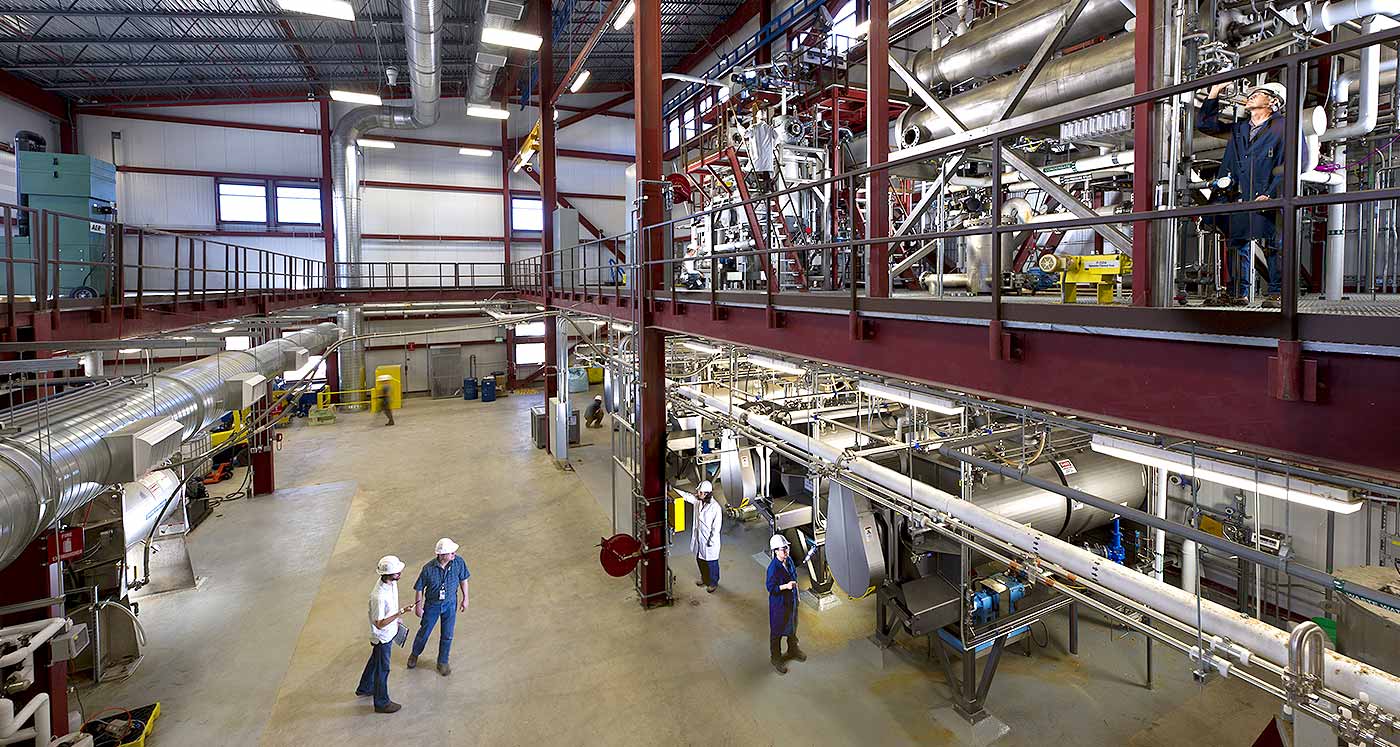
NLR's 27,000-ft2 high-bay advantaged chemical pilot plant accommodates bench-to-pilot-scale processes for converting cellulosic biomass into a variety of chemicals and fuels at process throughputs of up to 1 tonne of dry biomass per day.
Experiments in the Advantaged Chemical Conversion Pilot Plant are supported by NLR's technological scale-up and piloting research. NLR's analysis, characterization, modeling, and artificial intelligence research helps accelerate the translation of laboratory-scale conversion pathways to commercial-scale production.
Core Capabilities
NLR's Advantaged Chemical Conversion Pilot Plant includes the following capabilities:
- Bench- and pilot-scale biomass chemical impregnation and dewatering systems (screw presses)
- 1-L high-solids stirred batch reactor
- 4-L steam-injected batch reactor
- 130-L steam-jacketed and steam-injected batch paddle-type mixed reactor limited to temperatures below 160°C
- Continuous horizontal screw-type reactor, 100–200-kg/day (dry basis) capacity (140°C–210°C and 5–30-minute residence times)
- Continuous horizontal screw-type reactor, capacity of 0.5–1 tonnes of biomass per day (dry basis) (140°C–210°C and 3–120-minute residence times)
- Continuous vertical reactor, capacity of 0.7–1 tonnes of biomass per day (dry basis) (140°C–200°C and 1–60-minute residence times)
- Continuous vertical reactor, capacity of 0.5–1 tonne biomass per day (dry basis) capacity (140°C–210°C and 10–40-minute residence times), with an inline secondary reactor for optional treatment at lower temperatures
- All reactor systems have multiple options for pretreatment catalysts
- High-solids bench-scale tumbling reactors (up to 10 L)
- 1,900-L hot-water jacketed paddle reactor for high-solids slurries
- Four 4,000-L hot-water jacketed paddle reactors for semi-continuous processing at total solids loadings greater than 20% (w/w)
- Multiple standalone fermentation systems from 15-L to 100-L scale
- Pilot plant fermentation train consisting of two 160-L seed production vessels, two 1,500-L seed production vessels, and four main 9,000-L fermentation vessels
- All vessels can be operated in batch, fed-batch, or continuous mode of operation
- Continuous high-temperature, short-residence-time sterilizer
- Solid-liquid separation systems, including solid-bowl and perforated-bowl centrifuges
- Semi-continuous pressure belt filter
- Forced-recirculation evaporator
- 19-sieve tray distillation column
Research in the biochemical conversion pilot plant taps into NLR's suite of special-purpose laboratories, including:
- Compositional analysis
- Process engineering and economic analysis
- Molecular biology
- Microscopy analysis
- Rheology and particle size characterization
- High-throughput processing and analysis
- Computational modeling.
Contact
Work With Us
Learn how to work with NLR to develop, translate, and de-risk bioeconomy innovations for market readiness.
Share

Last Updated July 16, 2026