
Research and Development Laboratories
NLR's special-purpose R&D laboratories include facilities and equipment to design and optimize processes to convert biomass and waste feedstocks into polymers, chemicals, and fuels; make fundamental discoveries in biology; and separate critical minerals from complex resources.
NLR's Algae Cultivation Facility houses custom-built photobioreactors to simulate algae growth environments.
Capabilities include:
- Light and temperature scripts that can be programmed to mimic selected outdoor climate environments up to a maximum light intensity of 4,200 µmol/(m2·s) and temperatures fluctuating between 10°C and 38°C
- Forty-two available positions, each with individual carbon dioxide delivery controlled through a custom pH feedback system and up to 2 L of cultivation volume
- Algae cultivation accompanied by a suite of extensive water chemistry analysis and characterization.
Contact
Lieve Laurens
Researcher
Lieve.Laurens@nlr.gov
NLR's Anaerobic Digestion Laboratory carries out testing and evaluation of anaerobic digestion processes under Biosafety Level 2 operations, allowing work with manure and sewage in addition to food waste, biomass, and other feedstocks. Digestions range from 50-mL serum bottles to 1-L bottles.
The lab includes three automated methane potential testing systems (2 × 15 [500 mL] and 1 × 6 [2 L]) with automated mixing, temperature control, and gas volume measurement.
Biogas is analyzed for methane, carbon dioxide, and hydrogen by gas chromatography, and organic acids are measured by high-performance liquid chromatography and gas chromatography–mass spectrometry.
Total volatile fatty acids, ammonium, alkalinity, and chemical oxygen demand are measured with industry-standard Hach assays.
Contact
Steve Decker
Scientist
Steve.Decker@nlr.gov
The 2-in. fluidized-bed reactor system provides a valuable intermediate scale between microscale and larger pilot-scale experiments. In its current configuration, it receives solid biomass in a continuous flow of up to 0.5 kg/h and converts it via pyrolysis or gasification to liquid and gaseous fuel precursors, as well as solid and gaseous coproducts.
Primary reaction products can be further upgraded by downstream catalytic reactors (fixed-bed and fluid-bed) to evaluate and compare biomass feed materials, catalysts, and reactor conditions to identify promising processes for the economic production of chemicals and fuels from biomass.
The system is designed to facilitate complete collection and measurement of all reaction products, generating high-quality data and mass balance closures of 100% ± 1%.
Contact
Calvin Mukarakate
Group Research Manager
Calvin.Mukarakate@nlr.gov
NLR has multiple laboratories for enzyme engineering that feature high-throughput and automated systems, including Opentrons OT-2 and Hamilton STAR systems.
Robotics platforms have custom protocols for enzyme expression, purification, and assaying. The Hamilton system is useful for automating library preparation and for directed evolution campaigns. The labs also have more than eight fast protein liquid chromatographers for protein purification at multiple scales.
Capabilities include cell-free bioprocessing to build pathways for in vitro production of molecules and polymers, expertise in interfacial biocatalysis for enzymes acting on solid substrates such as polysaccharides and plastics, and structure-guided and machine-learning-guided enzyme and protein engineering. There are also capabilities in protein immobilization and long-term stability testing for projects in multiple spaces, including plastics recycling, biochemical synthesis, and critical materials recovery.
These laboratories are also equipped with a full suite of enzyme kinetics measurement capabilities including a spectrophotometer and biophysical assay equipment such as differential scanning calorimetry, circular dichroism spectroscopy, quartz crystal microbalance with dissipation monitoring, and surface plasmon resonance.
Contacts
Gregg Beckham
Senior Research Fellow
Gregg.Beckham@nlr.gov
Yannick Bomble
Group Research Manager
Yannick.Bomble@nlr.gov
NLR's Biomass Catalyst Characterization Laboratory is a comprehensive materials characterization and performance testing laboratory.
Material characterization capabilities span a range of physical and chemical techniques, including elemental analysis, surface area analysis, acid site characterization, X-ray diffraction, proximate analysis, thermogravimetric analysis, infrared spectroscopy, and gas chromatographic analysis.
Catalyst performance is measured in microactivity test systems.
Contact
Anne Starace
Researcher
Anne.Starace@nlr.gov
The Catalyst and Materials Synthesis Laboratory has capabilities to support the production of nanostructured materials using air-free manipulation and reaction techniques.
It has six 8-ft chemical fume hoods that are fully equipped for synthesis of air-stable and air-sensitive organic and organometallic compounds as well as inorganic materials. It is also equipped with an MBRAUN solvent purification system, Schlenk vacuum lines for synthesis and manipulation of air-sensitive materials, and three Vacuum Atmospheres glove boxes for storage and handling of air-sensitive materials.
Characterization capabilities include an Agilent Cary ultraviolet-visible (UV-Vis) spectrophotometer and a Malvern Panalytical Zetasizer Nano dynamic light scattering and zeta potential measurement system.
Contact
Susan Habas
Senior Scientist
Susan.Habas@nlr.gov
NLR's Catalyst Manufacturing Laboratory enables flexible manufacturing for catalyst forming and scale-up using industrially relevant unit operations from the scale of grams to tens of kilograms.
Hardware capabilities include high-shear and high-volume solids and fluids mixing, thermal processing in rotary calcination or muffle furnaces, single-screw and piston-driven extrusion, pellet size reduction and impregnation, and mechanical property testing (e.g., crush strength).
Contact
Fred Baddour
Researcher
Frederick.Baddour@nlr.gov
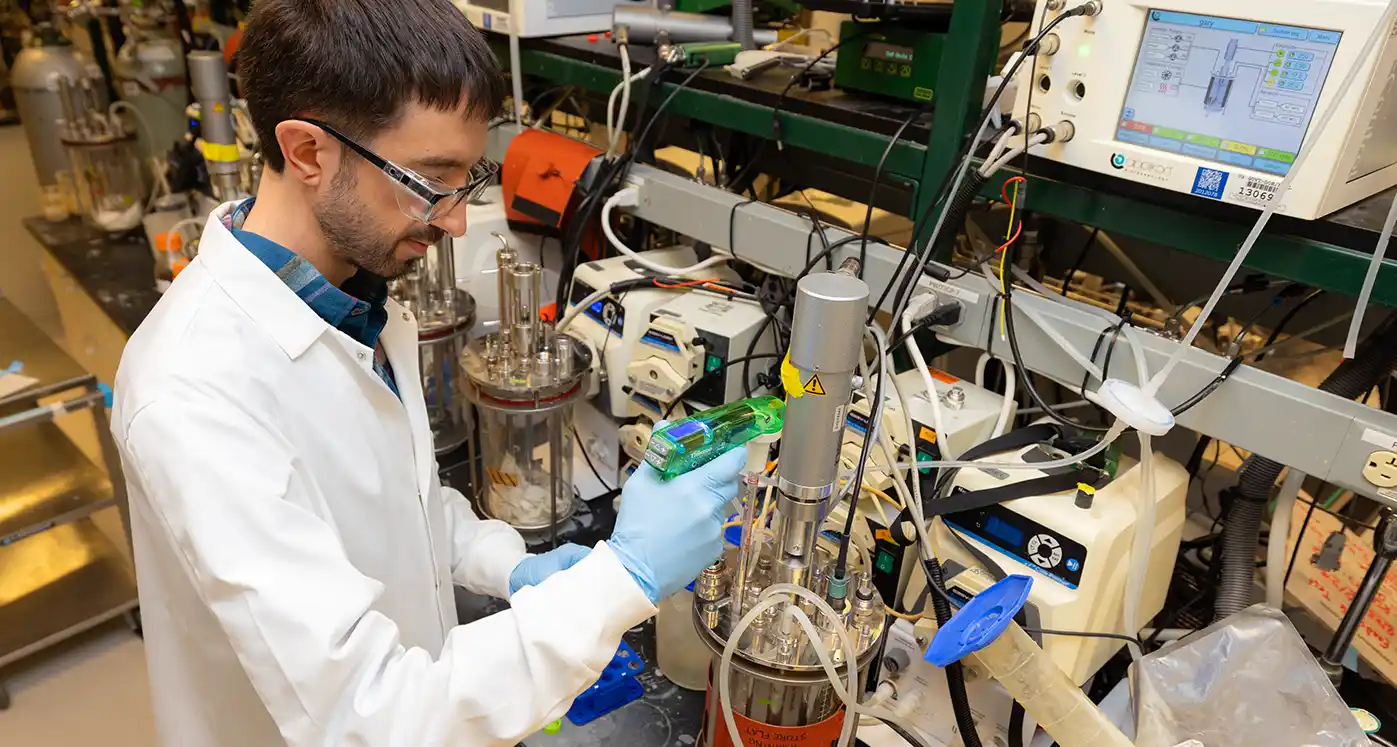
NLR has decades of experience with applied fermentation science at different scales, using two primary fermentation laboratories.
NLR's first fermentation laboratory includes two 8-L (Belach Bioteknik) and five 3-L (Applikon) fermenters. All are fully controlled bioreactors suited to perform cultivations with Risk Group 2 materials (e.g., disease-causing biological agents), as well as substrates with high solids content. The laboratory also contains bench incubators (for small-scale cultivations) and analytical capabilities to perform initial characterization of organic waste feedstocks and reactor effluents.
NLR's other primary fermentation laboratory includes multiple floor and bench incubators for shake flasks, as well as two 0.2-L (Applikon) and 0.5–10-L bench-scale fermenters, 33 0.5-L bioreactors (Sartorius), 26 1-L bioreactors (Applikon), and two 5-L and two 10-L bioreactors (Eppendorf). All bioreactors are equipped with pH, optical dissolved oxygen, temperature, and foam control probes and sensors; agitation control; and air/inert gas sparge systems. Most bioreactors are equipped with online mass spectrometry-based off-gas analysis systems that allow continuous monitoring of oxygen, carbon dioxide, and other metabolic byproducts. These bioreactors can be controlled by custom vendor software to program different cultivation strategies. Offline analyses, including sugar and ammonia profiling and optical density measurements, are available to complement process monitoring and control.
Contacts
Nancy Dowe (Farmer)
Researcher
Nancy.Dowe@nlr.gov
Violeta Sànchez i Nogué
Senior Researcher
Violeta.SancheziNogue@nlr.gov
NLR's Fluid-Bed Research Gasifier tests new feedstocks, including shredded municipal solid waste (i.e., garbage), by evaluating fluidized-bed materials, reforming catalysts, and process conditions without the risk of shutting down a pilot-scale or full-scale plant.
It is a continuous-feed gasifier (feed rate 0.3–2 kg/h) with online analysis for characterization, mass balances within 5% of full closure, and the option of a fixed-bed catalytic reformer and amine scrubber.
Contact
Anne Starace
Researcher
Anne.Starace@nlr.gov
NLR's Fuel Synthesis Catalysis Laboratory is a purpose-built facility designed for testing heterogeneous catalysts in their role of converting biomass intermediates to chemicals and fuels.
Capabilities include:
- A variety of reactor systems, customized for the challenges of biointermediate upgrading, that can be used to test various materials and process conditions
- Eight independent reactor bays equipped to handle new designs or customer-supplied equipment
- In-house-developed, partner-supplied, and purchased catalysts that can be tested across operating conditions that span 0–2,000 psig (pressure), 150°F–1,800°F (temperature), permanent and condensable gases, liquids, and vaporizable
solids at the gram to kilogram scale
- Full process automation that allows for extended operation up to thousands of hours
- Product analysis achieved through online chromatography and mass spectrometry and a multitude of offline techniques, including nuclear magnetic resonance, high-performance liquid chromatography, scanning electron microscopy with X-ray microanalysis, transmission electron microscopy, X-ray diffraction, Fourier-transform infrared spectroscopy, and Raman spectroscopy.
Contact
Dan Ruddy
Principal Scientist
Dan.Ruddy@nlr.gov
The Furans Upgrading and Process Intensification Laboratory develops and de-risks catalytic upgrading of biomass-derived furans to fuel- and chemical-grade intermediates.
Using flow and batch reactors with integrated separations and solvent recycle, researchers execute dehydration (sugars to furfural/hydroxymethylfurfural), hydrogenation/ring rearrangement, aldol condensation (homogeneous/heterogeneous), and hydrodeoxygenation.
Research is supported by high-performance liquid chromatography/gas chromatography-flame ionization detection analytics:
- Continuous flow dehydration skid (heated tubular reactor, pumps, and back pressure regulator): Mixed sugars to furfural/hydroxymethylfurfural in acetone/water
- Acetone recovery/distillation (fractionating column, condensers, and receivers): Solvent recycle and humins capture
- Thermo Reacti-Therm batch reactors (multi-position): Aldol condensation with compounds such as NaOH and MgO–Al2O3, as well as small-scale hydrodeoxygenation
- Liquid–liquid extraction station: Phase separation and product/catalyst recovery
- Büchi rotary evaporator (vacuum plus cold trap): Concentration and solvent exchange
- High-performance liquid chromatography (ultraviolet/refractive index) and gas chromatography-flame ionization detection: Sugars, furans, ketones, and aldol products
- General wet chemistry infrastructure: Fume hoods, flammables storage, balances, hot plates/stirrers, and waste management.
Contact
Ashutosh Mittal
Researcher
Ashutosh.Mittal@nlr.gov
NLR's Integrated Chemistry Laboratory has three bench top hoods, two walk-in hoods, and three highly ventilated reactor pods set up for pre-pilot and pilot demonstrations.
Available reactors include:
- Banks of six-well Parr 75-mL reactors (stainless steel, Hastelloy, and titanium)
- An instrumented Parr 25-L stainless steel batch reactor
- A titanium Parr 20-L batch reactor for high-temperature, high-pressure, and corrosive chemistries
- A 1-L titanium continuous stirred-tank reactor with an automated solids feeder using an extruder
- An alloy Parr 1-L reactor primarily used for polymerization reactions and smaller reactors with liquid and gas sampling
- An Integrated Lab Solutions custom-built 32-well reactor system with separate temperature and pressure control pairs, which operates at pressures up to 100 bar and temperatures up to 300°C.
The lab includes several Parr 5400 flow reactors for high-temperature, high-pressure chemistries; a two-bed µ-proportional-integral-derivative reactor with in situ catalyst characterization; and multiple, custom-built, single- and multi-bed flow reactors with online analytics including gas chromatography, mass spectrometry, and Fourier-transform infrared, including those that can use ammonia and other reactive gases.
It features a comprehensive suite of catalyst characterization capabilities, including chemisorption, physisorption, Brunauer–Emmett–Teller analysis, Raman spectroscopy, X-ray diffraction, and X-ray photoelectron spectroscopy, among others.
Contacts
David Brandner
Group Research Manager
David.Brandner@nlr.gov
Gregg Beckham
Senior Research Fellow
Gregg.Beckham@nlr.gov
NLR's Polymer Synthesis, Analysis, and Characterization Laboratories can characterize plastics for their structure and thermomechanical properties and understand the synthesis, processing, and deconstruction of polymers across their life cycle.
The laboratories are equipped for monomer and polymer synthesis at scales ranging from 50 mg to 1 kg and deconstruction at scales up to 10 kg.
They leverage other NLR capabilities, such as the Nuclear Magnetic Resonance Facility, while relying on a large suite of gel permeation chromatography instruments (e.g., high-temperature hexafluoroisopropanol gel permeation chromatography), thermal instruments (differential scanning calorimetry, thermogravimetric analysis, and dynamic mechanical analysis), tensile and compression testing (1-kN and 10-kN load frames), pendulum impact testing, drop tower impact testing, Fourier-transform infrared spectroscopy, and rheology.
These labs also provide the capability to make alpha prototypes of composite panels, thermoformed specimens, and fibers using small-scale extrusion, ideal for technology transfer between NLR and multiple key stakeholders.
Equipment includes hot melt presses, resin transfer molding, small-scale twin-screw extrusion, and fiber processing.
Additional capabilities include composability tests, permeability testing, melt indexing, color and haze measurements, and fiber testing.
Contacts
Nic Rorrer
Manager and Distinguished Member of Research Staff
Nicholas.Rorrer@nlr.gov
Kat Knauer
Postdoctoral Liaison Coordinator
Katrina.Knauer@nlr.gov
NLR's Protein Purification and Characterization Laboratory enables native and recombinant protein characterization.
The lab includes AKTA liquid chromatography systems for isolation and purification of proteins of interest, biophysical characterization (circular dichroism and quartz crystal microbalance with dissipation monitoring), enzyme assays, high-throughput recombinant expression, and biochemical screening with automated Opentrons and Hamilton robotics.
Contacts
Alissa Bleem
Researcher
Alissa.Bleem@nlr.gov
NLR's Thermochemical Microreactor Laboratory comprises three systems for milligram- to gram-scale biomass thermochemical conversion R&D, coupled to molecular beam mass spectrometry, gas chromatography, and gas chromatography–mass spectrometry for product analysis.
Contact
Calvin Mukarakate
Group Research Manager
Calvin.Mukarakate@nlr.gov
NLR's separations laboratories enable development and integration of advanced product separation technologies from laboratory- to pilot-scale operations. Researchers work closely with multiple industry partners, as separations are often a key driver of techno-economic performance in industrial-scale processes. Separation of biological and critical materials streams is accelerating the nation's progress toward securing reliable and affordable domestic critical minerals and materials supply chains.
Key capabilities include counter-current chromatography, bench- to pilot-scale simulated moving bed chromatography, liquid-liquid extraction, dead-end and crossflow filtration, rotating ceramic disk filtration, spinning band distillation, and multiple bespoke and unique in situ and continuous product recovery setups.
The labs house a variety of ceramic membranes (1-kDa molecular weight cutoff to 50 kDa) and hold similar polymeric membrane separation systems.
The labs include multiple jacketed rotary ceramic disc filters (10 kDa–200 Da) that can operate in environments up to 20% solids by weight for filtering difficult or viscous solutions, spanning both bench and pilot scale.
A custom-built in situ product recovery system is available and can be employed in process-intensified applications to remove products as they are produced in condensed-phase reactions at the 1–10-L scale, including from biocatalytic (enzyme or microbe) reactions and chemocatalytic reactions.
The labs also house a continuous counter-current chromatography system and a dry-column vacuum chromatography system capable of handling 50 g of crude material per run.
The labs include a 16-column simulated moving bed chromatography system capable of multiple modes of operation such as A/B/C separation with continuous chromatography, expanded-bed adsorption chromatography, continuous ion exchange, and adsorption/desorption mode.
Beyond chromatography and filtration, a spinning band distillation system with 30 theoretical trays, a flash drum, and 10-tray Oldershaw columns for continuous distillation applications are available, with access to microfiltration and ultrafiltration.
The labs have automated systems for membrane aging, resin aging, and general process agent lifetime testing that can operate in an automated fashion for thousands of cycles.
Contacts
Gregg Beckham
Senior Research Fellow
Gregg.Beckham@nlr.gov
Work With Us
Learn how to work with NLR to develop, translate, and de-risk bioeconomy innovations for market readiness.
Share

Last Updated Aug. 21, 2026