
Featured Equipment
NLR's featured equipment supports specialized research on the production of alternative chemicals, fertilizers, materials, and fuels.
NLR leverages deep reinforcement learning and artificial intelligence approaches to enable autonomous, high-throughput infrastructure for biology and microbiology research.
NLR's molecular microbiology and synthetic biology capabilities include automated microbial engineering and screening, high-throughput robotics systems for advanced microbial development, and high-throughput genome engineering and phenotyping.
Contact
Alissa Bleem
Researcher
Alissa.Bleem@nlr.gov
NLR houses dedicated test stands for:
- Carbon dioxide (CO2) electrochemical reduction
- Calibrated gas delivery and gas chromatography quantification for full mass balance
- Potentiostat power supply to monitor and track performance of single 5-cm2 cells to large-stack formats capable of converting up to 50 L/minute of CO2
- Integrated fermenters to test biorefinery CO2 flue gas upstream and convert intermediates biologically in the gas or conventional fermenters.
Contact
Michael Resch
Researcher
Michael.Resch@nlr.gov
NLR's Fourier-transform ion cyclotron resonance mass spectrometer has ultrahigh resolution (R > 2,000,000) and houses a 7-T magnet, making it a cutting-edge tool for molecular elucidation.
The instrument is equipped with four ionization sources (electrospray ionization, atmospheric pressure chemical ionization, atmospheric pressure photon ionization, and matrix-assisted laser desorption ionization) compatible with existing chromatography systems.
This instrument allows for the analysis of various sample types, ranging from hydrocarbon fuel feedstocks to finished fuels and degradation products, pyrolysis oil, vapor and conversion products, organic photovoltaics and organic batteries, biopolymers (including carbon fiber research), and global biological analyses of lipidomics, glycomics, and proteomics.
This platform represents ultrahigh-resolution mass spectrometry and enables advanced characterization of organic components and reactions, and molecular ions in complex mixtures, with unique elemental composition assignment in a rapid, automated manner.
Contact
Lieve Laurens
Researcher
Lieve.Laurens@nlr.gov
NLR has developed and built control systems that allow for modulation of gas compositions and flow rates to safely operate gas-fermenting bioreactors, pressure bottles, and tubes.
NLR's gas fermentation capabilities include:
- Dedicated gas fermentation for anaerobic and aerobic microbes with gas delivery of CO, CO2, H2, methane/biogas, and air
- Online gas chromatography for quantifying carbon conversion and metabolite profiling
- Integration with electrochemically produced CO and formate.
Contacts
Jonathan Humphreys
Researcher
Jonathan.Humphreys@nlr.gov
Michael Resch
Researcher
Michael.Resch@nlr.gov
NLR's membrane inlet mass spectrometer can measure dissolved gases and is fitted with a custom-designed glass cuvette with light and temperature controls for photosynthetic performance of algae and cyanobacteria. It has been used to measure inorganic carbon uptake rate, hydrogen flux, and oxygen and ethylene production rates.
Contacts
Paul King
Group Manager
Paul.King@nlr.gov
Jianping Yu
Researcher
Jianping.Yu@nlr.gov
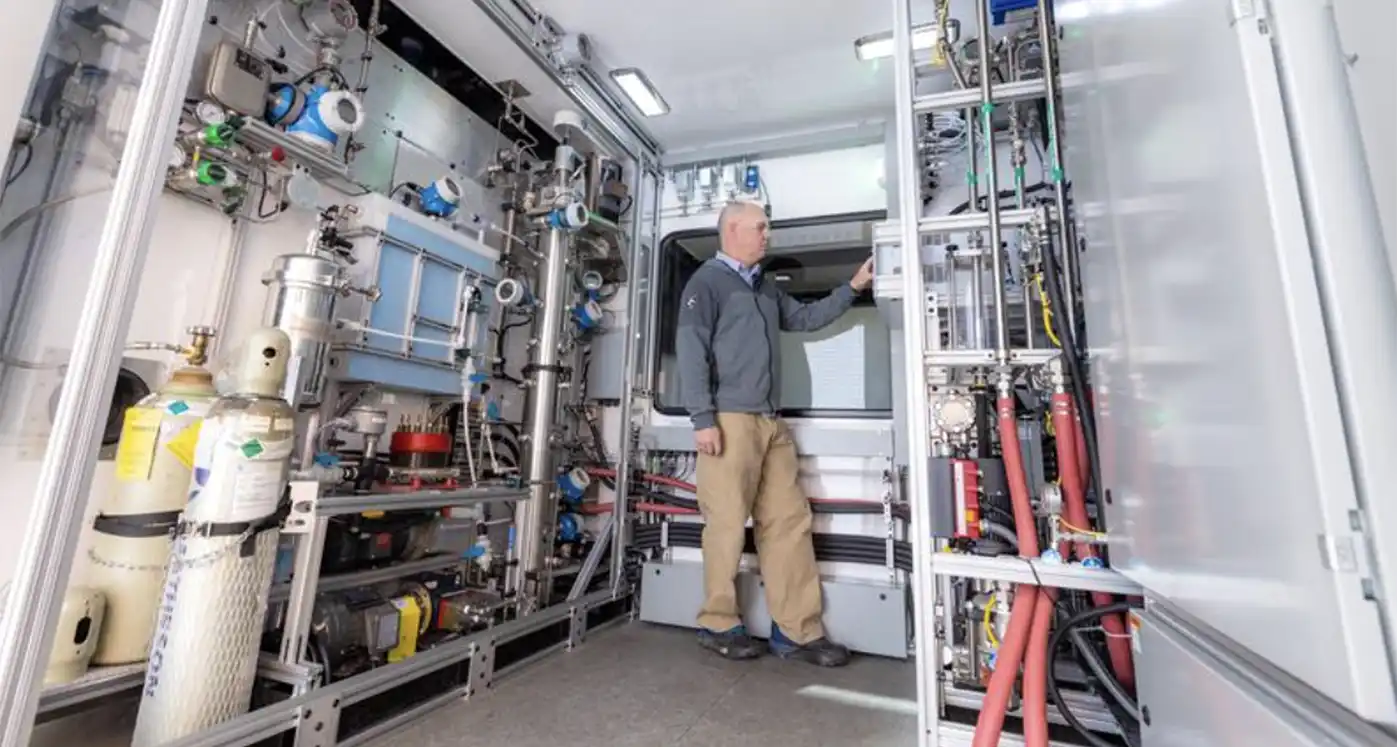
MIERA is a mobile and self-contained energy production system with the potential to be deployed anywhere in the world to turn waste into chemicals and fuels tailored to specific applications. This transportable, 16-ft trailer includes a state-of-the-art electrolyzer and a customizable bioreactor conversion system.
MIERA capabilities include:
- Feedstocks and energy generation
- 6-m3 mobile anaerobic digester that converts food and other waste to biogas
- Atmospheric water generation
- 3.5-kW solar photovoltaic system
- Input 208 V, three-phase, up to 100-A shore power required (typically 30 A or less)
- Integrated systems
- Insulated 16-foot-long trailer with a 10-foot test bay and 6-foot control room
- Air compressor for pneumatic valves and other subsystems
- 2-kW/2-kWh lithium-ion phosphate battery
- 2-ton air-source heat pump for heating and air conditioning
- Innovative photovoltaics-to-electrolyzer stack power conversion
- Bioreactor and electrolyzer
- 20-L, 18-bar, 1,000-rpm agitator bioreactor
- 100-ft3 Class I, Division 2, Group B and D electrically classified area
- 3–25-kW proton exchange membrane electrolyzer for hydrogen production
- Gas detection (H2, CH4, H2S, and O2) and product gas analyzer.
Contact
Nancy Dowe (Farmer)
Researcher
Nancy.Dowe@nlr.gov
NLR has six bench-scale revolving algae biofilm reactors, which support algae growth as an attached biofilm on a revolving belt partially submerged in liquid medium. These reactors are used to study algae biomass productivity, biomass composition, and resource (e.g., phosphorus) recovery when growing in various media such as anaerobic digester effluent.
Contacts
Mike Guarnieri
Researcher
Michael.Guarnieri@nlr.gov
Lukas Dahlin
Researcher
Lukas.Dahlin@nlr.gov
NLR's single-particle reactor can perform pyrolysis and gasification experiments on a particle up to 2 grams. The gas atmosphere (nitrogen, steam, air, and mixtures thereof) is precisely controlled, and the heating rate can reach up to 50°C/minute with a maximum temperature of 820°C. A viewport allows for optical observation during reactions, while sample weight and temperature are also recorded. The evolved gases are collected in a gas bag and characterized via gas chromatography. This tool is instrumental in developing particle-scale modeling and rapid screening of feedstocks.
Contact
Reinhard Seiser
Researcher
Reinhard.Seiser@nlr.gov
NLR's two packed-bed, bench-scale hydrotreaters operate at pressures up to 200 atm and temperatures up to 400°C. Maximum feed rates of up to 0.5 mL/hour and 0.5 L/hour, respectively, are available.
Contacts
Mickey Stone
Researcher
Mickey.Stone@nlr.gov/p>
Calvin Mukarakate
Group Research Manager
Calvin.Mukarakate@nlr.gov
The Soil SynCom, Microbiome, and Terrestrial Mesocosm Testbed enables quantitative tracking of specific strains of microbes, including rare or engineered microbes, within complex soil ecosystems and can detect compositional or genetic shifts that may indicate stress responses, microbial interactions, or potential horizontal gene transfer events.
The testbed integrates high-resolution sequencing (16S, ITS), digital droplet PCR, microscopy, and multi-omics workflows to characterize microbial community structure, behavior, and function in soils and terrestrial sorghum mesocosms.
It includes controlled-environment mesocosms, custom soil slurry assays, and high-throughput sample processing pipelines optimized for time-series experiments.
End-to-end analysis is supported through QIIME2, Greengenes2, microbial network inference, and machine-learning-based modeling pipelines to integrate taxonomic, functional, and targeted detection readouts.
Contact
Mike Guarnieri
Researcher
Michael.Guarnieri@nlr.gov
Work With Us
Learn how to work with NLR to develop, translate, and de-risk bioeconomy innovations for market readiness.
Share

Last Updated Aug. 14, 2026