
Thermal and Catalytic Process Development Unit
NLR's Thermal and Catalytic Process Development Unit (TCPDU) enables researchers and industry partners to test, develop, and de-risk reactors, filters, catalysts, and other bioenergy conversion unit operations based on thermochemical conversion of biomass.
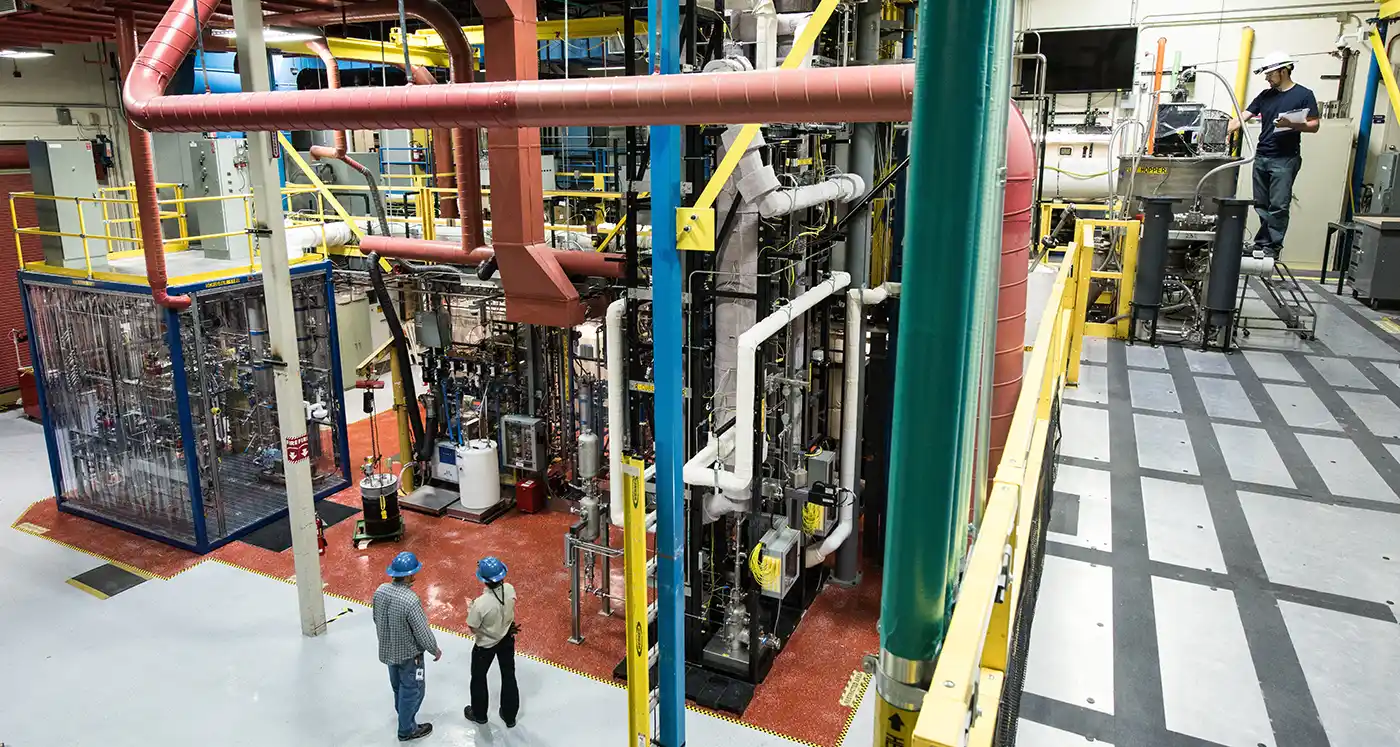
NLR's TCPDU is a flexible pilot plant for gasification and pyrolysis of biomass and other waste feedstocks. The two-story facility features a fluidized-bed gasifier, a pyrolyzer, and a catalytic pyrolyzer integrated with a riser/regenerator reactor configuration, along with extensive downstream processing and upgrading of syngas and bio-oil.
TCPDU experiments are supported by NLR's technological scale-up and piloting research. NLR's analysis, characterization, modeling, and artificial intelligence research helps accelerate the translation of laboratory-scale conversion pathways to commercial-scale production.
Capabilities
NLR's TCPDU core capabilities are described below.
Feed Processing
Feed processing capabilities include:
- A continuous loss-in-weight feeding system
- Integrated inline pellet crusher
- Rotary valve pressure isolation.
Gasification
When configured for gasification, the TCPDU comprises a fluid-bed reactor for initial volatilization of biomass, a thermal cracker to complete gasification, cyclones for char and ash collection, and a gas-scrubbing system. Three reforming reactors can be used independently or in parallel: fluid-bed, packed-bed, and recirculating-regenerating reactors. Online analytical capabilities include molecular beam mass spectrometry, gas chromatography, thermal conductivity detection, and nondispersive infrared. Partners can use the TCPDU to test catalysts or bring their own skid to attach to the TCPDU to test syngas upgrading technologies.
Pyrolysis
The TCPDU can be configured for fast pyrolysis and catalytic fast pyrolysis. An entrained-flow reactor is used to generate the pyrolysis vapors, cyclones to collect char and ash, and a spray condensation train to collect the final products. A recirculating-regenerating riser reactor can be used to catalytically upgrade the pyrolysis vapors. Online analytical capabilities include molecular beam mass spectrometry, gas chromatography, thermal conductivity detection, and nondispersive infrared. Partners can use the TCPDU to test catalysts or bring their own unit operations to attach to the TCPDU to test their pyrolysis technologies.
Solids Removal
The continuous cyclonic solids removal system removes residual biomass char and ash with collection for mass balance.
Gas Cleanup
Gas cleanup capabilities include:
- A 14-in.-diameter full-stream fluidized-bed reformer operating up to 925°C for semi-batch catalytic reforming of residual tar and hydrocarbons
- A recirculating-regenerating reformer system operating at up to 950°C for full-stream continuous tar and hydrocarbon reforming and catalyst regeneration.
Dedicated Analytics
Dedicated analytics include:
- A molecular beam mass spectrometer for real-time, high-temperature process analysis at multiple process conditions and locations
- Light hydrocarbon, permanent gas, and sulfur and nitrogen compound speciation by gas chromatography and infrared analysis for real-time analysis at multiple process locations.
Contact
Work With Us
Learn how to work with NLR to develop, translate, and de-risk bioeconomy innovations for market readiness.
Share

Last Updated July 27, 2026