
Battery Safety Database
The Battery Safety Database contains data related to the safety and thermal behavior of current and next-generation batteries—from commercial lithium-ion cells to next-generation chemistries including solid-state, sodium-ion, and potassium-ion cells.
The individual materials and thermal behaviors that constitute a battery cell play a pivotal role in determining its safety and overall performance. A comprehensive evaluation of these properties can yield cost-effective solutions that enhance both performance and safety of battery designs, reducing reliance on expensive battery management systems.
The information compiled by NLR in this database spans work performed in collaboration with the National Aeronautics and Space Administration (NASA) as well as the University of Texas at Austin. NLR's approach begins with detailed material property characterization to evaluate the microstructural, thermal, electrical, mechanical, and electrochemical performance of batteries. This multifaceted approach ensures a thorough understanding of the factors influencing battery safety and efficiency. This database includes multimodal and multilength characterization datasets that provide a comprehensive description of key safety characteristics for different battery types.

Testing
Electrode Level
Pack Level
Cell Level



Impact
Policy and Society
First Responder Practices
Pack Design
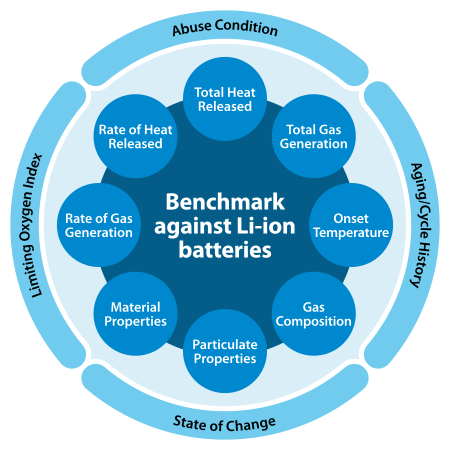
An example of a comprehensive battery safety characterization campaign that this database aims to emulate. Safety evaluation occurs from the materials level to the system level and encompasses various abuse types, cell conditions, and cell operational histories.
Material Property Characterization
A variety of in-depth material property characterization experiments were conducted to evaluate the microstructural, thermal, electrical, mechanical, and electrochemical performance of industry-leading battery chemistries. This includes microstructure analysis using 3-D X-ray nano-computed tomography (nano-CT); electrode-level examination to assess heat capacity, electronic conductivity, and load-displacement response; and cell-level evaluations on rate performance and hybrid pulse power characterization.
Material characterization spans numerous properties—including specific heat capacity, electrode microstructures, electronic conductivity, tensile testing, compression testing, rate testing, and high-power pulse characterization—for seven battery chemistries. Based on their needs, users can download this characterization data packaged by battery chemistry or property.
Electrode microstructures (NMC811 | Gr, LCO | LVO, DRX | Si-HC, NNFMO | Na, and PBA | Gr)
Material-Level Thermal Behaviors
NLR uses differential scanning calorimetry for characterization of materials-level thermal behavior, including cathode active materials, anode active materials, electrolytes, and separators. The data supports identification of self-heating onset temperatures and the distinct sources of heat in full cells.
By utilizing both high-pressure differential scanning calorimetry and thermogravimetric analysis, energy release diagrams can be generated for various state of charge conditions as well as for individual components or full cells. Users can download material-level thermal behavior data for different chemistries.
Cell-Level Thermal Behaviors
NLR researchers use closed chamber accelerating rate calorimetry on small cells (<3 Ah) to characterize thermal behaviors.
Separately, NLR hosts the Battery Failure Databank, which stores hundreds of datasets from fractional thermal runaway calorimetry on larger cells (>3 Ah).
Thermal Runaway Emissions
NLR researchers used X-ray nano-computed tomography to visualized particle morphological properties from soot that emerged during thermal runaway of commercial lithium-ion batteries. The resulting 3-D images for lithium-ion batteries (NCA, Gr) are provided as raw TIFF files.
Post Thermal Runway Particulate Analysis
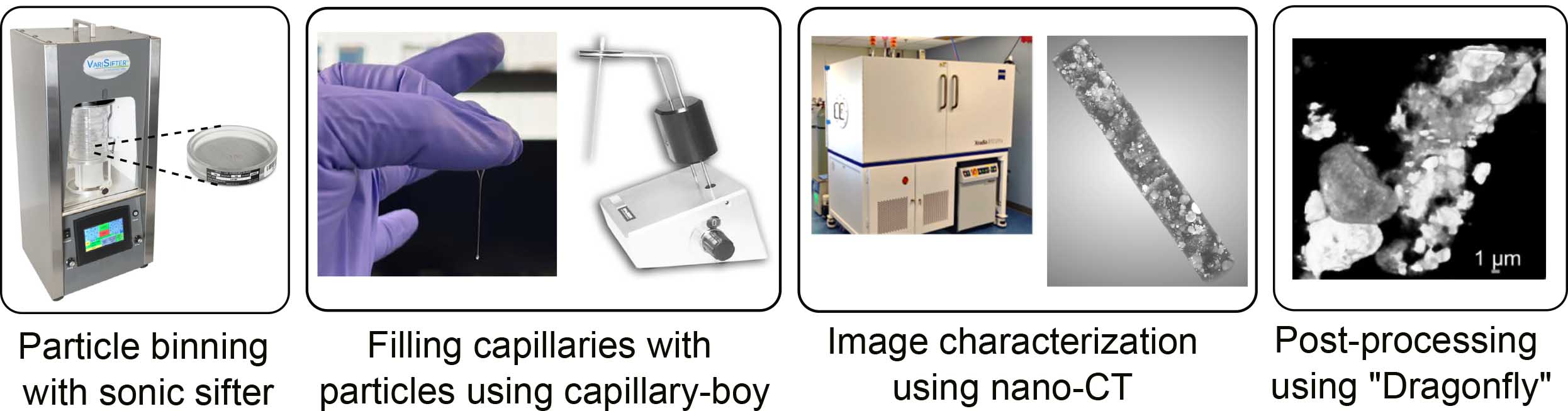
Workflow to characterize the microstructure of soot generated during a thermal runaway event in a lithium-ion cell, using X-ray computed tomography.
Failure Modes, Mechanisms, and Effects Analysis
A Failure Modes, Mechanisms, and Effects Analysis (FMMEA) is a systematic methodology for identifying potential failure mechanisms, their associated failure modes, and their effects. This analysis helps prioritize failure mechanisms based on their associated risks, enhancing decision-making and risk management processes.
The practice of an FMMEA involves thoroughly evaluating a system's behaviors, vulnerabilities, and failure points throughout its operational life and analyzing its failure modes, their likelihoods, and their consequences. Here, we conduct an FMMEA on cell-level behavior for a range of next-generation cell chemistries. Conducting the FMMEA at the cell level, rather than module or pack level, encourages a focus on how cell materials are adversely affected by a range of operational conditions, including fast charge, fast discharge, and operation at low or elevated temperatures.
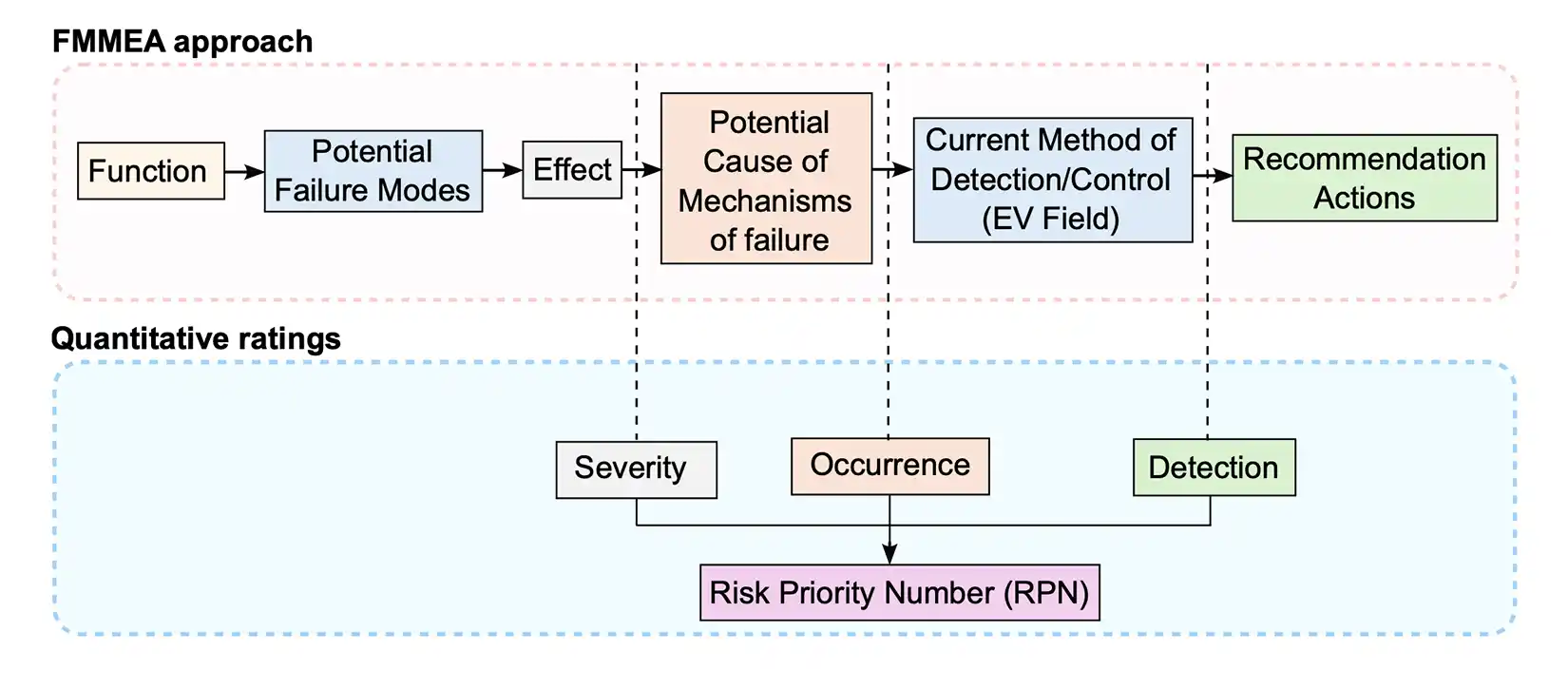
Flowchart illustrating the FMMEA approach and the quantitative ratings used to calculate the risk priority number for various battery chemistries in electric vehicle applications.
In collaboration with Underwriters Laboratory and Sandia National Laboratories, NLR has conducted FMMEA of nine next-generation chemistries.
Publications
Addressing the Safety of Next-Generation Batteries, Nature (2025)
Particulate Analysis of Post-Thermal Runaway Soot of Li-Ion Battery Using X-Ray Computed Tomography, arXiv (2026).
The Battery Failure Databank: Insights from an Open-Access Database of Thermal Runaway Behaviors of Li-Ion Cells and a Resource for Benchmarking Risks, Journal of Power Sources (2024)
Contact
Share

Last Updated June 24, 2026